Tropical Climate Padel Court Guide: Design, Materials & Costs 2026
In a tropical climate the court itself is only half the project — heat, monsoon rain and salt air decide which materials survive and how many hours a day the court can be booked. A tropical-ready padel court means six design decisions (orientation, shade, ventilation, drainage, materials, lighting), hot-dip galvanized steel of 80-100 µm with SUS304 stainless fasteners, UV-resistant turf, and a realistic budget 10-25% above a temperate-climate quote. Singapore — this site's largest audience market — is adding clubs faster than most of Europe, and because no court is manufactured locally, every Singapore project imports. Here is what those buyers check before signing.
In This Guide
- Why do tropical climates change every court decision?
- What are 6 design decisions for a tropical court?
- Which materials survive heat, rain and salt air?
- How do ventilation and heat management work?
- How should foundation and drainage handle monsoon rain?
- What do tropical upgrades cost in 2026?
- What is the Singapore and Southeast Asia market snapshot?
- What is the import checklist for tropical buyers?
- Tropical Padel Court FAQ

1. Why do tropical climates change every court decision?
Build the same court in Singapore and in Germany and you get two completely different assets. In a tropical climate four forces attack a padel court simultaneously: UV radiation that degrades turf fibre and membrane coatings, salt air and humidity that corrode steel within years, monsoon rain that tests drainage and foundations, and heat that empties courts between 11:00 and 18:00. A court that survives 15 years in Europe can be structurally compromised in 5-7 in the tropics if the specification is wrong.
The revenue side matters just as much. Artificial turf in full sun can exceed 65°C — surface temperatures above 90°C have been recorded on hot afternoons — and inside single-layer covered courts air temperatures commonly reach 40-45°C at midday. Players do not book those hours. A club that solves shade and ventilation reclaims roughly 40-50% of its daytime capacity, which is usually the difference between a 2-year and a 4-year payback. The 2026 market data says investors have noticed: the global padel clubs market is estimated at about US$2.8 billion in 2026, heading to US$8.3 billion by 2035 (12.93% CAGR), and the fastest-growing regions are all in the tropics — Southeast Asia, the Middle East and Latin America.
That is why tropical buyers do not shop for "the same court as Europe". They shop for climate-engineered courts. The sections below walk through the design, materials, ventilation, drainage, cost and import decisions in the order a project actually makes them.
Get a Factory Quote in 12 Hours
Tell us your court count, country and timeline — we reply within 12 hours with factory-direct pricing, shipping and installation options. No obligation.
Prefer an instant answer? Ask the AI assistant at the bottom-right.
2. What are 6 design decisions for a tropical court?
Six decisions, made before the first foundation pour, determine how a court performs in heat, rain and humidity:
| Decision | Tropical specification | Why it matters |
|---|---|---|
| 1. Orientation | Long axis roughly north-south | Keeps the low afternoon sun off the players' sight lines and reduces west-side heat load |
| 2. Shading | Light-blocking PVC/PVDF membrane or canopy, UV blocking 85%+ | Shade lowers turf surface temperature dramatically and adds 4-6 bookable daytime hours |
| 3. Ventilation | Roll-up side panels + gable vents; mechanical 4-12 ACH for enclosed halls | An enclosed court traps heat like a greenhouse; airflow is the cheapest cooling system |
| 4. Drainage | 1-1.5% cross-slope on slab, perimeter French drains, monsoon-capacity gutters | Standing water degrades turf backing and creates slip hazards; tropical rain comes down in sheets |
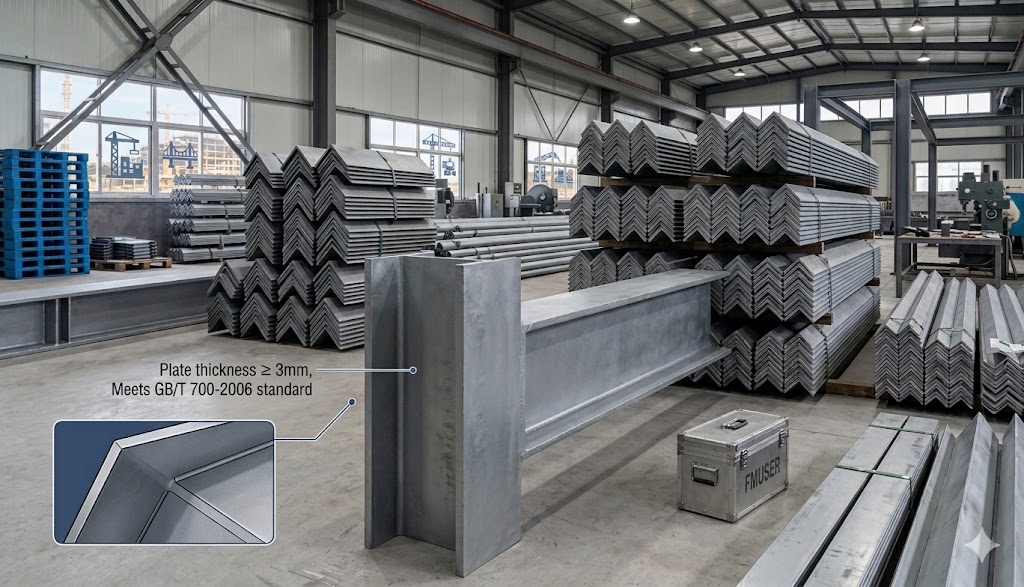
| 5. Materials | Hot-dip galvanized steel 80-100 µm, SUS304 fasteners, UV-stabilized turf | Corrosion and UV are the two silent killers in tropical installations |
| 6. Lighting | LED high-mast or wall-mounted, 300 lux recreational / 500+ lux competition, anti-glare | Night play is peak demand in the tropics; LEDs keep energy and heat low compared with metal halide |
Orientation is the one decision that costs nothing and cannot be fixed later. A court built with its long axis east-west takes the full force of the afternoon sun on the back glass, which turns the south side of the court into a wall of glare from roughly 15:00 onwards. The remaining five decisions are engineering choices — covered in the next sections — and most can be upgraded at the factory before shipping rather than retrofitted on site.
3. Which materials survive heat, rain and salt air?
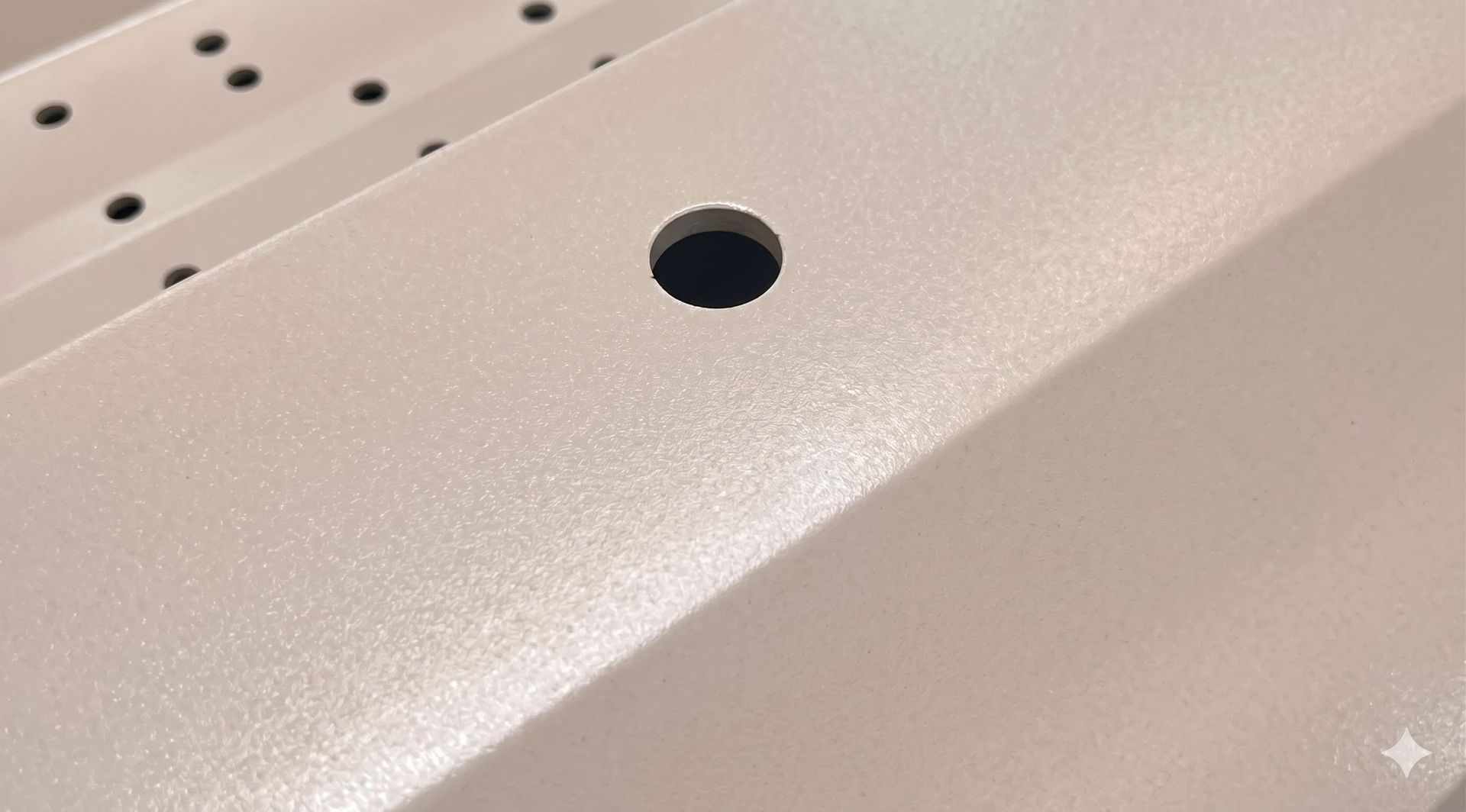
Material specification is where tropical projects are won or lost. In coastal cities like Singapore, Miami or Dubai, ordinary electro-galvanized frames show rust within 2-3 years; the correct specification lasts 15+. These are the numbers to put in writing:
| Component | Tropical spec to request | Failure if downgraded |
|---|---|---|
| Steel structure | Hot-dip galvanized, 80-100 µm zinc, Q235B/Q355B, duplex powder-coat finish for coastal sites | Corrosion at bolted joints and base plates; structural weakening within 5-7 years |
| Fasteners & brackets | SUS304 stainless steel (bolts, hinges, clamps) | Galvanized screws rust first and are the classic early-failure point in salt air |
| Artificial turf | 12mm monofilament or hybrid polyethylene with UV stabilizers, 12-15 kg/m² silica sand infill | Fibre fading, embrittlement and backing degradation under continuous equatorial sun |
| Glass panels | 12mm tempered safety glass (10mm minimum), full-perimeter frames | Thermal stress from heat expansion; thinner glass flexes in strong wind |
| Membrane (if covered) | PVC-coated polyester 700-900 g/m² or PVDF 1050 g/m², UV top-coat, class B s2 d0 fire rating | Sagging, UV aging and 5-8°C higher indoor temperatures with translucent single-layer tents |
| Coating certificates | Zinc thickness report per batch + salt-spray test results (e.g. ASTM B117) | No certificate = no way to verify the coating that keeps the frame alive |
Two traps are common in tropical quotes. First, suppliers quote "hot-dip galvanized" without the zinc thickness — tropical and coastal sites need the top of the range (80-100 µm), and the coating certificate should come with every batch. Second, UV-resistant turf is treated as an optional upgrade
4. How do ventilation and heat management work?
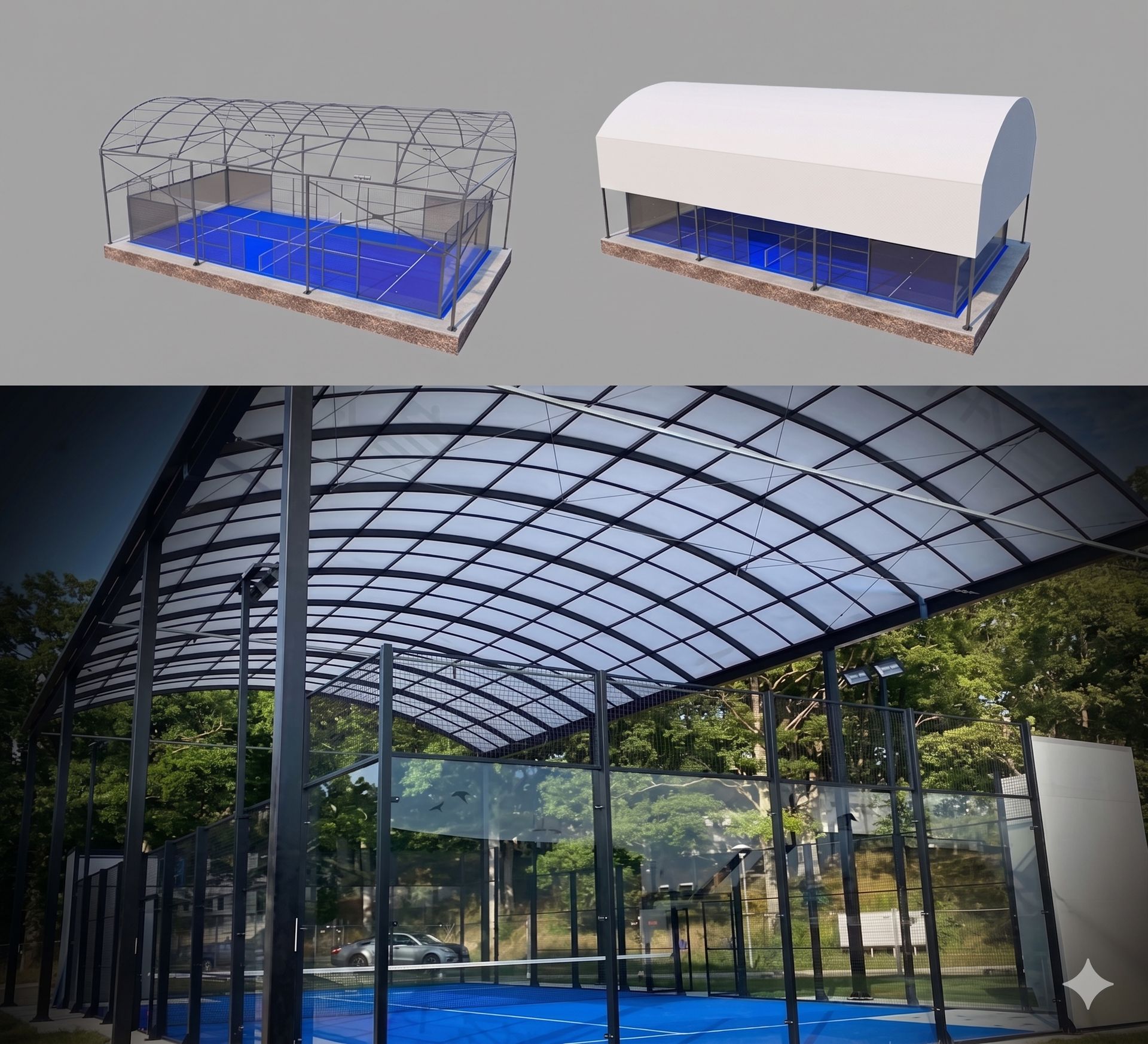
A padel court is a glass and mesh enclosure — four walls that block crosswind by design. Add a roof and it becomes a greenhouse. Temperature control is therefore a design task, not an accessory. The ventilation options, in order of cost:
| Solution | Typical effect | Best for |
|---|---|---|
| 1. Roll-up side panels + openable doors | Natural cross-ventilation at court level | Covered courts in any tropical market; near-zero cost |
| 2. Gable vents / ridge ventilation | Hot air escapes at the top (stack effect) | Pairs with side panels; works even when panels are closed in rain |
| 3. Light-blocking PVC membrane | Reduces indoor temperature by 5-8°C vs translucent tents | All covered courts — the single most effective passive upgrade |
| 4. Mechanical ventilation | 4-12 air changes per hour, humidity control to 40-60% RH | Enclosed halls and multi-court facilities; keeps glass free of condensation |
| 5. Evaporative cooling | Comfortable play conditions in dry heat (40-60% RH target) | Markets with low humidity — parts of the Middle East and Australia |
| 6. Full air conditioning | 16-20°C indoor target, premium experience | Flagship venues; Singapore's SPH Pickle Padel runs AC daily 11:00-21:00 |
The pragmatic club standard is passive-first: light-blocking membrane, roll-up sides and gable vents, with mechanical ventilation added for enclosed halls. Full air conditioning roughly doubles the climate-control budget and is a positioning decision — it lets a club charge premium court rates, but it is not what most buyers need to fill daytime slots. If you are planning an indoor facility, our indoor vs outdoor guide covers ceiling height, humidity and building envelope trade-offs in depth.
5. How should foundation and drainage handle monsoon rain?
Tropical rain is not a drizzle; it is 100-200 mm falling in a couple of hours. Three rules keep a court playable the morning after a storm:
- Slope the slab, don't level it. A 1-1.5% cross-slope drains surface water off the court instead of pooling at the glass line. Flat slabs are the number one drainage failure in tropical courts.
- Perimeter French drains with capacity. Gravel-filled drains around the court perimeter, sized for the local 100-year storm, keep water away from the slab edge where it undermines the base.
- Design for the water table and wind. In low-lying sites (parts of Singapore, Bangkok, coastal Florida) the slab may need raising; in typhoon and cyclone zones the foundation and anchoring must be engineered to the local wind code, with the structural calculation note signed by an engineer.
For covered courts, the roof drainage is part of the same system — valley gutters and downpipes sized for tropical intensity, discharging into the perimeter drains. Ponding on a membrane is the leading cause of premature roof failure, so the gutter design belongs in the contract, not left to the installer. Our covered padel court guide details roof systems, clear heights and the 2026 structure market if a full roof is on your list.
6. What do tropical upgrades cost in 2026?
An FIP-compliant turnkey court in a temperate climate typically lands in the US$65,000-115,000 band depending on site, country and finish. Tropical specifications add a predictable premium. Indicative 2026 ranges:
| Upgrade | Indicative range | Notes |
|---|---|---|
| Corrosion package (80-100 µm galvanizing + duplex coating + SUS304) | +5-8% vs standard spec | Non-negotiable in coastal and humid sites; covered by coating certificates |
| UV-stabilized turf upgrade | +US$800-1,500 per court | 12mm monofilament with UV stabilizers; baseline for equatorial sun |
| Shade canopy (single court) | from ~US$30,000 | Light-blocking membrane, steel frame; range varies with span and membrane grade |
| Mechanical ventilation package | project-quoted | Fan and duct system for enclosed halls; driven by court count and ACH target |
| Evaporative cooling / AC | premium, project-quoted | AC roughly doubles the climate budget; evaporative cooling is a lower-cost middle ground in dry heat |
| Monsoon drainage package | +US$2,000-4,000 | French drains, oversized gutters and downpipes; site-dependent |
Because freight, customs, GST and site access vary dramatically, we never quote a fixed all-in number. Factory-direct supply from China plus local assembly is the standard structure for Singapore and Southeast Asian projects — the court ships as a complete engineered kit with documentation, and a local crew handles the slab and erection. Send your site conditions to our engineering team and you will receive an itemized quote with climate upgrades separated from the base court, plus freight and installation scope. For a full component breakdown, our padel court cost guide lists every line item.
7. What is the Singapore and Southeast Asia market snapshot?
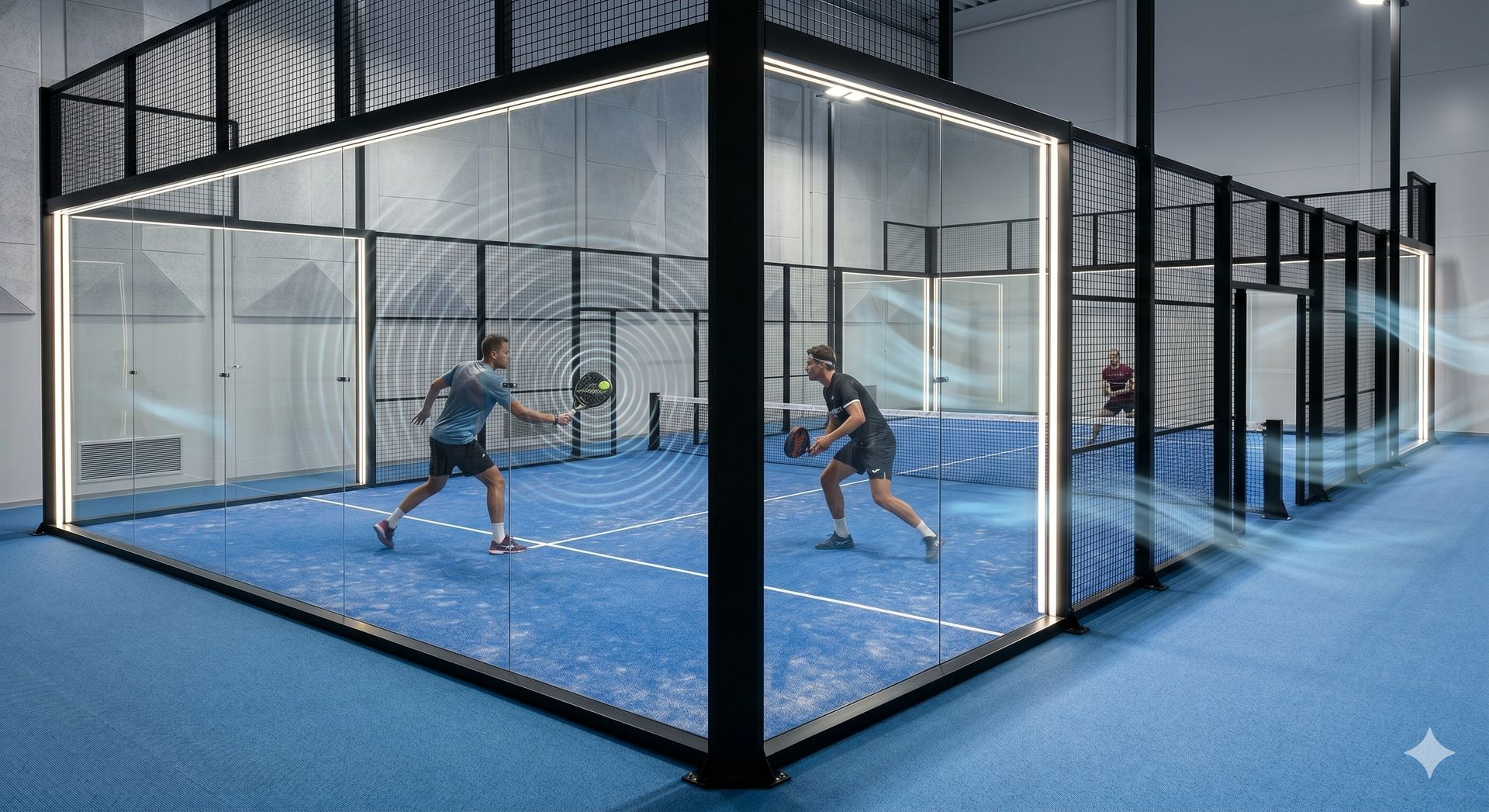
Singapore is the clearest signal that tropical padel has crossed into the investment mainstream. SPH Pickle Padel opened the city's first fully indoor, air-conditioned court hall at Singapore Expo — six pickleball and three panoramic padel courts across 1,200+ m², with AC running daily from 11:00 to 21:00. Around it, a dense club ecosystem is forming: The Cage Padel Tribe books courts through Playtomic, Dealmakers Padel Club runs four sheltered courts, and Padel Station operates panoramic courts with premium club amenities. Southeast Asian analysts describe the region as following Spain's playbook a decade later — urban, experience-driven, club-led growth.
Three facts matter to any supplier or investor watching this market:
- Every court is imported. There is no domestic padel court manufacturer in Singapore — every club project sources its structure, glass, turf and lighting from abroad, and Chinese factories supply the large share of that volume.
- Climate-engineering is the differentiator. Clubs compete on sheltered or air-conditioned play, which is exactly the design and materials story of this guide — corrosion-proof frames, UV turf, ventilation and drainage are sales features in Singapore, not afterthoughts.
- Density drives fast payback. Land-scarce Singapore prices court time at a premium; sheltered multi-court clubs maximize bookable hours per square metre, which is why covered and indoor configurations dominate new projects.
For a buyer in Singapore, Jakarta, Bangkok, Manila or Dubai, the practical question is the same: which factory can ship a climate-engineered court with the certificates, drawings and support to get it erected and playing quickly? The checklist below is what our Singapore and regional clients sign off before the container leaves.
8. What is the import checklist for tropical buyers?
Use this checklist when comparing factory-direct quotes. Every item should be answered in writing before you sign:
| # | Check item | Acceptance criteria |
|---|---|---|
| 1 | Galvanization standard | Hot-dip galvanized 80-100 µm with per-batch zinc thickness certificate + salt-spray test (e.g. ASTM B117) for coastal sites |
| 2 | Fastener specification | SUS304 stainless bolts, hinges and brackets — not galvanized |
| 3 | Turf specification | 12mm UV-stabilized monofilament/hybrid polyethylene, 12-15 kg/m² silica sand infill, UV warranty in writing |
| 4 | Glass specification | 12mm tempered safety glass (10mm minimum) with certificates for the glass standard |
| 5 | Wind & rain engineering | Structural calculation note for your site's wind zone and rainfall intensity, signed by a qualified engineer |
| 6 | Drainage design | Slope, French drains and gutter sizing shown on the drawings, not assumed |
| 7 | Documentation pack | CE / ISO certificates, material certificates, assembly manual, 3D drawings, maintenance checklist |
| 8 | Logistics scope | Incoterm, freight estimate, customs paperwork (Singapore GST 9%), delivery window and local assembly scope in writing |
PeakPadel engineers tropical-ready court packages — corrosion-protected structure, UV turf, glass, LED lighting and documentation as one factory-warrantied system, with climate options (canopy, ventilation, drainage) quoted as separate line items. Every shipment includes the documentation pack above, and our shipping guide walks through freight, customs and delivery for Southeast Asia and the Middle East step by step.
9. Tropical Padel Court FAQ
What is the most important specification for a tropical padel court?
Corrosion protection: hot-dip galvanized steel at 80-100 µm zinc (duplex powder-coat for coastal sites) and SUS304 stainless fasteners. UV-resistant turf and 12mm tempered glass come second, because equatorial sun and salt air attack those components over time.
How hot does a padel court get in tropical conditions?
Turf in full sun can exceed 65°C (150°F), with surface readings above 90°C recorded on hot afternoons. Covered courts with translucent single-layer tents reach 40-45°C at midday; light-blocking PVC membranes cut that by 5-8°C.
Does a tropical padel court need air conditioning?
Not necessarily. Passive measures — orientation, light-blocking membrane, roll-up side panels, gable vents — keep most courts playable. Mechanical ventilation (4-12 air changes per hour) is the standard upgrade; AC is the premium option used by flagship venues and roughly doubles the climate budget.
How much does a padel court cost in Singapore or Southeast Asia?
A turnkey FIP-compliant court typically ranges from about US$65,000, with climate upgrades adding roughly 10-25%. Freight, Singapore GST (9%) and local installation are quoted separately because they depend on site access and crane availability.
How often must a tropical padel court be maintained?
Roughly twice as often as a temperate court: turf brushing and sand redistribution every 2-4 weeks, drainage clearing before and after monsoon seasons, quarterly corrosion inspection, and more frequent glass cleaning because humidity promotes algae and mineral film.