Covered Padel Courts: Roof Types, Costs & the 2026 Spain Market
The roof — not the court — is what turns an outdoor padel court into a year-round revenue asset, and it is also the component where buyers lose the most money. A covered padel court means six main roof systems, a minimum 6m (ideally 8m) internal clearance, hot-dip galvanized steel with PVC/PVDF membranes as the club standard, and European structure costs starting around €41,000 for a single court. In Spain — the world's largest padel market with nearly 17,000 courts (FIP, 2024) — covered and indoor conversions are the fastest-growing segment, because the roof, not the court, decides how many bookable hours a club sells.
In This Guide
- Why cover a padel court and what is the revenue math?
- What are the 6 roof systems and what does each one suit?
- What key specs must buyers verify?
- What are the covered court cost ranges in 2026?
- How is Spain's market of 17,000 courts driving the cover boom?
- What is the buyer's checklist for importing roofs from China?
- Covered Padel Court FAQ
1. Why cover a padel court and what is the revenue math?
How much does a covered padel court cost?
A covered padel court is usually quoted in two parts: the court itself and the roof structure. Indicative 2026 ranges in Europe: a single-court roof structure from roughly €41,000, a double-court structure from about €65,000, and three-to-four-court halls up to €130,000+ — excluding foundations, transport and installation. Importing the structure from a Chinese factory can cut the roof component significantly, which is why most buyers compare factory-direct supply plus local assembly.
What is the minimum height for a covered padel court?
FIP requires a minimum clear height of 6m above the playing surface, and 8m is recommended for new covered facilities so lobs and lighting mounts never interfere with play. The internal clearance at the eaves, not the ridge, is the figure that governs the design.
What are the main types of padel court roofs?
Six systems are used commercially: court-integrated canopies (frame bolted to the court), free-standing frame canopies, clear-span modular halls, retractable roof systems, air-supported domes, and permanent steel or concrete halls. Fixed steel-frame canopies with PVC-coated polyester or PVDF membranes are the global standard for club projects.
How many padel courts are there in Spain?
Spain has nearly 17,000 padel courts across about 4,500 clubs and facilities (FIP, 2024), roughly one court per 2,800 people — among the highest density in the world. Catalonia and Andalusia each have more than 3,200 courts, followed by Madrid with about 2,300 and the Valencian Community with almost 2,000.
What should buyers check when importing a covered padel court structure?
Check six things: hot-dip galvanized steel (80-100 µm zinc) with material certificates, membrane weight and fire rating (PVC-coated polyester 700-900 g/m², class B s2 d0 or better), wind and snow load calculations for your site, CE/ISO documentation, a signed factory acceptance checklist, and a clear breakdown of freight, customs and local assembly scope.
An uncovered court earns nothing in rain, and in most of Europe it loses bookable hours to heat, wind and short winter daylight. The business case for a covered padel court is simple: roofing converts weather-dependent hours into guaranteed revenue. A club that can book a court from 08:00 to 23:00 in any weather sells roughly 30-50% more playable hours per year than the same club with exposed courts — which is why almost every serious 2026 club project we quote includes a roof decision from day one.
| Scenario | Outdoor court | Covered court | Impact of the roof |
|---|---|---|---|
| Bookable hours (typical European climate) | ~2,200 h/year | ~3,300 h/year | +50% capacity from weather independence |
| Hourly court rate (indicative) | €13-26 | €15-30 | Premium pricing is accepted for covered play |
| Maintenance exposure | Turf wear from sun & rain cycles | Protected turf, slower degradation | Lower resurfacing frequency |
| Competitive position | Commodity offer | Differentiated offer | Members choose the covered club |
The roof is also the project's critical path. In most jurisdictions a padel court alone can be installed without a building permit, but a permanent roof almost always triggers planning permission, structural calculations and often a building permit. That means the roof sets the schedule — start the permit and engineering work before you order the steel, not after. Our indoor padel court requirements guide covers the building-side constraints in detail.
Get a Factory Quote in 12 Hours
Tell us your court count, country and timeline — we reply within 12 hours with factory-direct pricing, shipping and installation options. No obligation.
Prefer an instant answer? Ask the AI assistant at the bottom-right.
2. What are the 6 roof systems and what does each one suit?
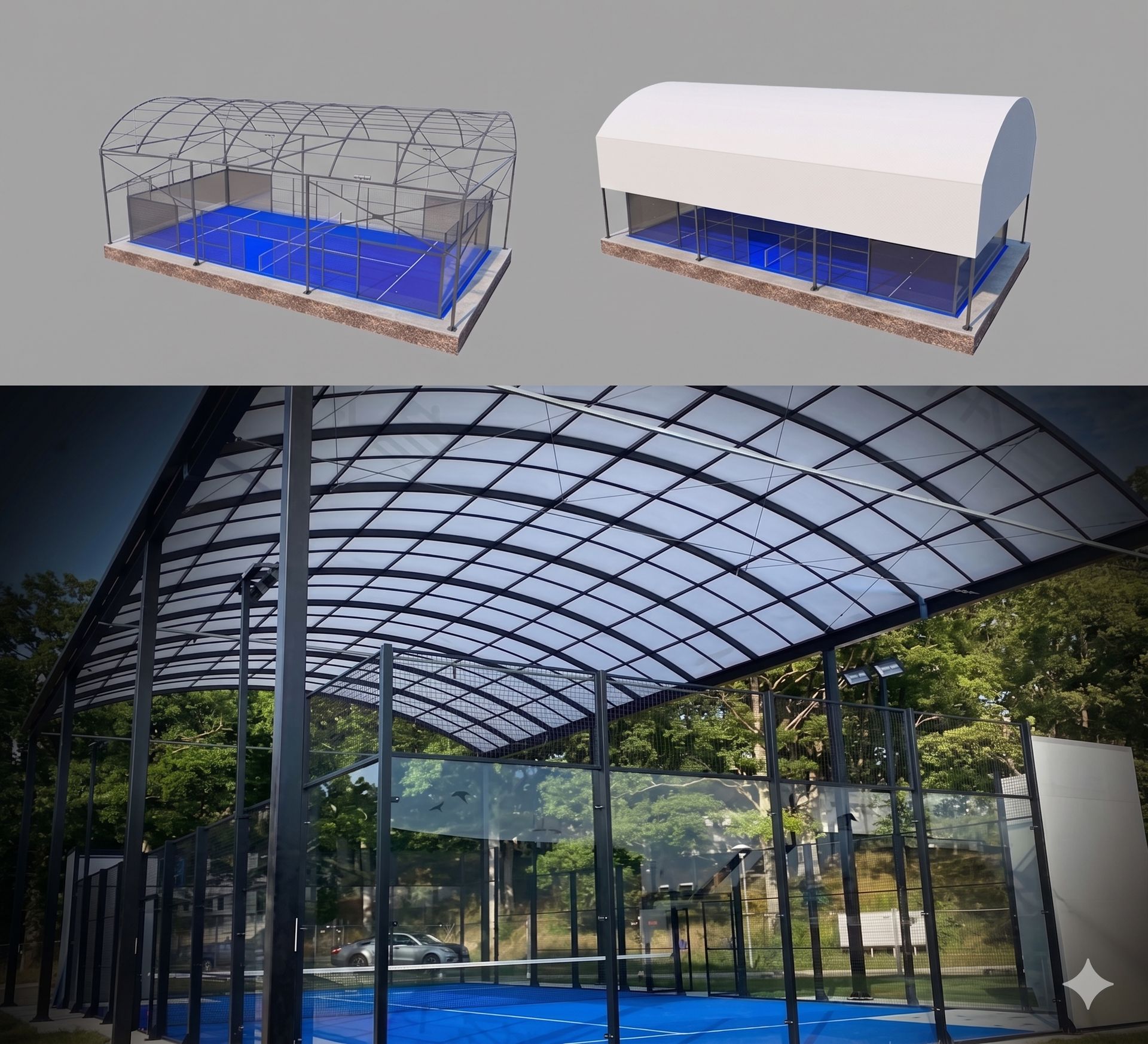
Every covered padel court sold commercially today uses one of six systems. None is universally right — the choice depends on court count, climate, planning constraints and budget:
| Roof system | Typical span | Cost profile | Best for |
|---|---|---|---|
| 1. Court-integrated canopy | Single court (~11 x 21 m) | Lowest | Retrofitting one court; frame bolts to the court structure |
| 2. Free-standing frame canopy | 1-2 courts | Low-mid | Existing courts where the court frame cannot carry roof loads |
| 3. Clear-span modular structure | 2-6 courts | Mid | New clubs; one structure, shared columns, cheapest per court |
| 4. Retractable roof system | 1-2 courts | High | Premium clubs wanting open-air play in summer, cover in winter |
| 5. Air-supported dome | 1-4 courts | Mid (higher running cost) | Seasonal or fast-deploy projects; needs continuous air pressure |
| 6. Permanent steel / concrete hall | 4+ courts | Highest | Multi-court facilities and municipal projects with a long horizon |
The global club standard is the fixed steel-frame canopy with a PVC-coated polyester or PVDF membrane — mature engineering, moderate price, and 10-year-plus life when the membrane is specified correctly. Two courts under one clear-span structure cost significantly less per court than two separate canopies, because you save one row of columns, one foundation line and one drainage run.
One profile dominates real projects: the curved roof. The arc is not cosmetic. Water travels along the curvature to a defined edge line instead of sitting on the membrane, so the rainwater and snow load leaves the structure instead of loading it, and the fall across the court is kept to the 1:100 maximum. What that changes in the order — spans (10.6 × 20.6 × 8.8 m one-piece, 12 × 22 × 8.8 m split), membrane weight, wind and snow load cases and the drawing pack that comes with an order are all specified on that page.
3. What key specs must buyers verify?
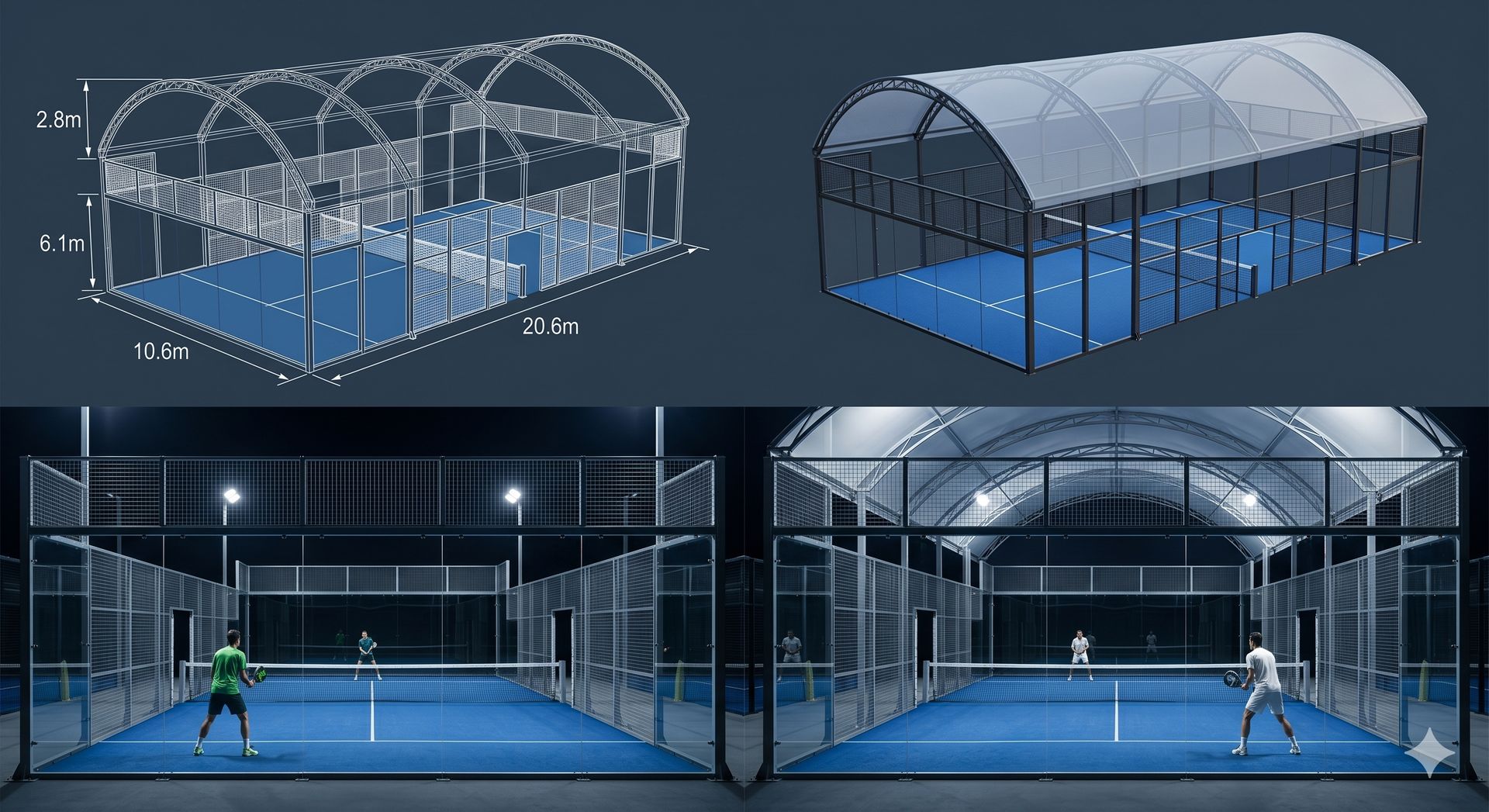
Roof quotes look similar on paper; the specifications underneath decide whether the structure lasts 5 or 15 years. These are the numbers to put in writing:
| Parameter | Spec to request | Why it matters |
|---|---|---|
| Internal clear height | Min 6m at every point, 8m recommended | Lobs and lighting mounts must never intrude; the eaves govern, not the ridge |
| Steel | Hot-dip galvanized, 80-100 µm zinc | Coastal and humid climates corrode electro-galvanized frames within years |
| Membrane | PVC-coated polyester 700-900 g/m², or PVDF 1050 g/m² | Weight and top-coat decide UV life, tension stability and appearance |
| Fire rating | Class B s2 d0 or better (EN 13501) | Required for public buildings and most club insurance policies |
| Wind & snow load | Calculated for your site's zone | Ask for the structural calculation note signed by an engineer |
| Drainage | Designed valley and gutter system | Ponding on a membrane is the number one cause of premature failure |
| Fasteners | SUS304 stainless steel | Any steel bolt on a 15-year structure must not corrode |
| Ventilation | Openable side panels or gable vents | Stops condensation and heat build-up; covered courts get hot fast in summer |
Two specification traps are common. First, suppliers quote a "6m structure" meaning ridge height — the usable clearance at the eaves can be well below 6m, which fails FIP requirements for lob play. Confirm clearance at the lowest point of the roof, not the highest. Second, membrane weight is often silently downgraded from 900 to 700 g/m² to win the price — the difference shows up as sagging and UV degradation within 3-5 years. Put the exact weight and fire class in the contract.
4. What are the covered court cost ranges in 2026?
A covered padel court is always quoted as two line items: the court and the roof. Indicative European ranges in 2026 (structure only, excluding foundations, transport and installation):
| Scope | Indicative 2026 range | Notes |
|---|---|---|
| Single-court roof structure | from ~€41,000 | Court-integrated or free-standing canopy, basic spec |
| Double-court structure | from ~€65,000 | One clear span; cheaper per court than two singles |
| Triple / quadruple hall | up to ~€130,000+ | Permanent hall with higher engineering and finish |
| Retractable system | premium, project-quoted | Mechanical system cost varies heavily by span and automation |
| Transport + assembly (per project) | ~€12,000-27,000 | Driven by distance, crane availability and crew days |
Factory-direct supply changes the picture. Chinese manufacturers ship the complete steel + membrane roof system at a fraction of European structure prices, and European buyers typically combine factory-direct supply with a local assembly contractor. Because freight, customs and site access vary dramatically, we never quote a fixed all-in number — send your site conditions to our engineering team and you will receive an itemized quote with the roof separated from the court, plus the freight and installation scope spelled out. For the court itself, our padel court cost guide breaks down every component.
5. How is Spain's market of 17,000 courts driving the cover boom?
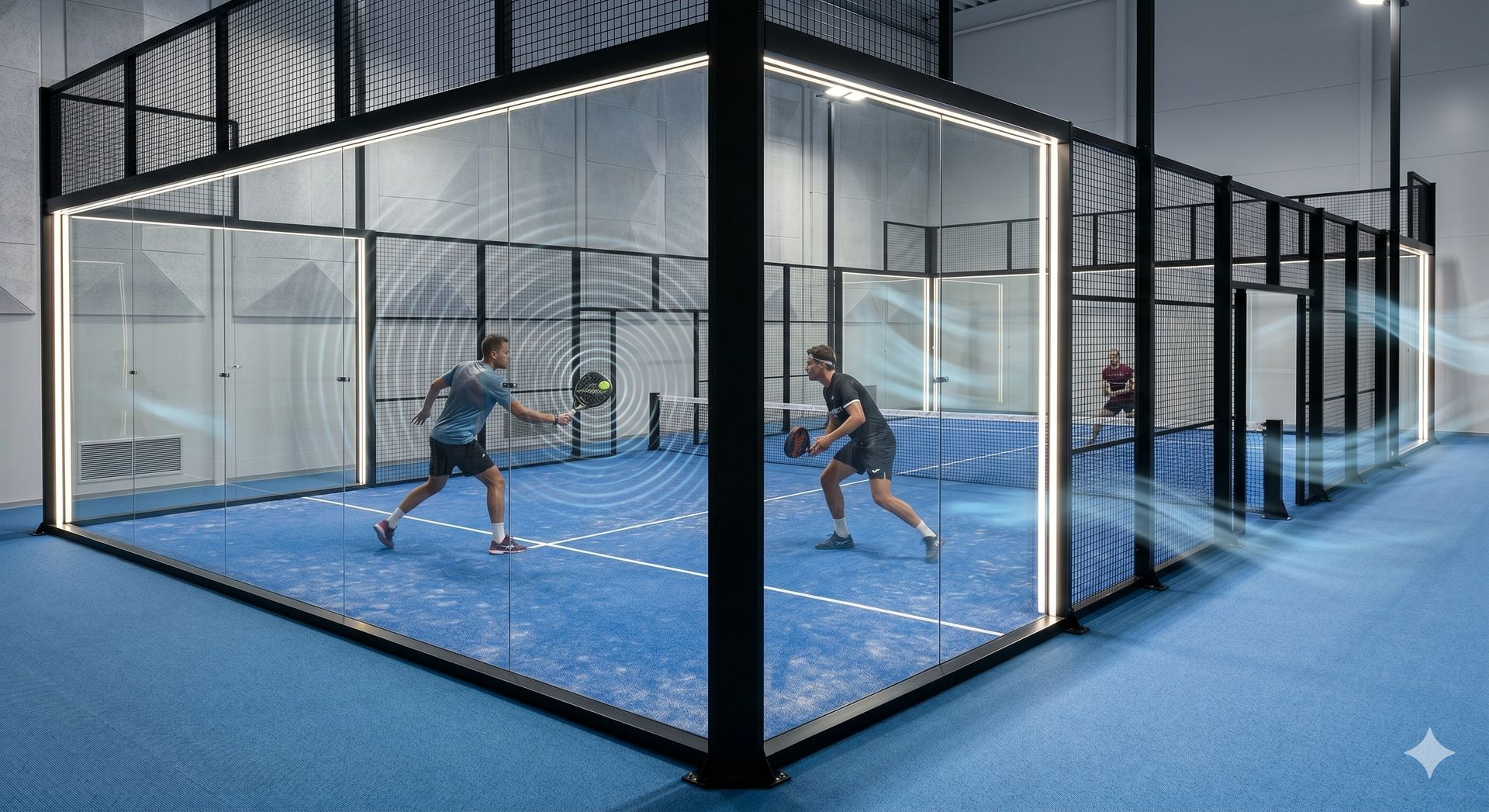
Spain is the world's reference market for padel — and the numbers explain why the cover boom is happening there first. According to FIP data, Spain has nearly 17,000 padel courts across about 4,500 clubs and facilities, a 5% increase on the previous year and one court for every 2,800 people, among the highest density anywhere. The regional leaders are Catalonia and Andalusia with more than 3,200 courts each, Madrid with about 2,300, and the Valencian Community with almost 2,000. Federated player licences hit a record 109,040 in 2024 (+8% year on year), while surveys put the total playing population above 6 million people — over 12% of the Spanish population.
That installed base is now being upgraded. Thousands of outdoor courts built during the 2015-2022 boom are reaching the point where adding a roof is cheaper than the land to build another court — clubs in Andalusia and Valencia, where summer heat already forces afternoon closures, are the most active in converting. The implication for buyers: the roof market in Spain is growing faster than the court market, and it is dominated by local installers working with imported steel and membrane systems. A factory-direct supply contract with local assembly is the standard structure for importing clubs.
Spain also sets the quality benchmark for covered play. FIP-homologated courts with 8m internal clearance, 500+ lux LED lighting and 12mm tempered glass walls are the normal club specification — not the premium option. If you plan to sell court time to Spanish players (or compete with Spanish-built clubs anywhere in Europe), build to that bar. Our complete spec sheet guide lists every number to verify.
6. What is the buyer's checklist for importing roofs from China?
Chinese factories supply a large share of the steel and membrane structures used in Europe's covered court projects — but the savings only materialize if the specification is locked down before the container leaves. Use this checklist when comparing factory-direct quotes:
| # | Check item | Acceptance criteria |
|---|---|---|
| 1 | Galvanization standard | Hot-dip galvanized, 80-100 µm zinc, coating certificate per batch |
| 2 | Membrane specification | PVC 700-900 g/m² or PVDF 1050 g/m², class B s2 d0 fire rating, UV top-coat |
| 3 | Structural calculation note | Wind and snow loads for your site, signed by a qualified engineer |
| 4 | Clear height on drawings | Min 6m at the eaves, 8m recommended — verified on the section drawing |
| 5 | Fastener specification | SUS304 stainless bolts, hinges and brackets |
| 6 | Documentation pack | CE / ISO certificates, material certs, assembly manual, 3D drawings |
| 7 | Factory acceptance | Signed inspection sheet + time-stamped photos of the steel and membrane |
| 8 | Logistics scope | Incoterm, freight estimate, customs documentation and delivery window in writing |
PeakPadel supplies covered court packages — court, roof structure and lighting as one engineered system — so the interface between the court frame and the roof is designed and warrantied by a single factory instead of two suppliers arguing over who is responsible. That matters because the court-integrated canopy bolts directly to the court frame, and a mismatch between suppliers is the classic cause of on-site delays. Every order ships with the documentation pack above, and our shipping guide explains the freight and customs process for Europe step by step.
7. Covered Padel Court FAQ
How much does a covered padel court cost?
A covered padel court is quoted in two parts: the court and the roof. Indicative 2026 European ranges: single-court roof structure from about €41,000, double-court from about €65,000, and three-to-four-court halls up to €130,000+ — excluding foundations, transport and installation. Factory-direct import of the structure from China reduces the roof component significantly, which is why most buyers compare factory-direct supply plus local assembly.
What is the minimum height for a covered padel court?
FIP requires a minimum clear height of 6m above the playing surface, and 8m is recommended for new covered facilities. The clearance at the eaves — not the ridge — is the figure that governs the design, because lobs are played across the full width of the court.
What are the main types of padel court roofs?
Six systems: court-integrated canopies, free-standing frame canopies, clear-span modular halls, retractable roofs, air-supported domes, and permanent steel or concrete halls. Fixed steel-frame canopies with PVC/PVDF membranes are the global club standard.
How many padel courts are there in Spain?
Nearly 17,000 courts across about 4,500 clubs (FIP, 2024) — one court per 2,800 people. Catalonia and Andalusia lead with 3,200+ courts each, followed by Madrid (~2,300) and the Valencian Community (~2,000). Federated licences reached a record 109,040 in 2024.
What should buyers check when importing a covered court structure?
Eight items: galvanization standard, membrane weight and fire rating, structural calculations for your site, clear height on drawings, SUS304 fasteners, the documentation pack, a signed factory acceptance sheet, and the logistics scope in writing. On US projects two of those items change: the structural calculations are checked against ASCE 7 wind load and the state or local building code rather than the EN series, and our US padel court building-code guide lists what a plan reviewer asks to see.