Padel Court Specifications: Complete Technical Spec Sheet & Acceptance Checklist
A FIP-compliant padel court is a rectangle of 20m x 10m (interior) with a 0.5% tolerance, enclosed by 3m-high walls finished with 1m of metal mesh at the ends, and built on a surface flat to within 3mm per 3m. Every component — glass, mesh, turf, lighting and steel — has a verifiable number, and checking those numbers at the factory before shipment is what separates a 15-year court from a five-year problem. This guide gives you the complete spec sheet plus a printable factory acceptance checklist.
In This Guide
- What are the official padel court dimensions and tolerances?
- What are the specifications for end walls and side enclosures?
- What is the 12mm tempered glass panel specification?
- What are the metal mesh and fencing specifications?
- What are the playing surface turf, flatness, and drainage specs?
- What lux levels and EN 12193 lighting requirements apply?
- What are the net, post, and access door specifications?
- What are the steel structure and anti-corrosion specifications?
- What is included in the factory acceptance checklist?
- Padel Court Specifications FAQ
1. What are the official padel court dimensions and tolerances?
Every regulation padel court starts from the same rectangle. The International Padel Federation (FIP) defines the playing court as 10 metres wide by 20 metres long (interior measurements), with a permitted tolerance of 0.5%. That tolerance is not a design freedom — it is the maximum error a completed court may show before it is considered non-compliant.
| Measurement | FIP Specification | Why It Matters |
|---|---|---|
| Court length (interior) | 20.0 m (±0.5%) | Defines baseline rallies and wall rebound angles |
| Court width (interior) | 10.0 m (±0.5%) | Side-wall play geometry and service box size |
| Service line distance from net | 6.95 m | Standard service box depth for every level of play |
| Centre service line extension | 20 cm past the service line | Required marking for correct service zones |
| Line width | 5 cm | Line colour: preferably white or black, high contrast |
| Net height at centre / posts | 0.88 m / 0.92 m | Centre sag is a deliberate part of the FIP rule |
| Minimum clear height above court | 6 m (8 m recommended) | Allows defensive lobs; new facilities should target 8 m |
Two details buyers routinely miss. First, the 20m x 10m is the interior playing area — the court structure, door swings, safety clearance and maintenance access add roughly 1m per side, so a single court realistically occupies about 11m x 21m (or 22m x 12m if you want generous circulation). Second, the 6m minimum free height applies to the entire playing surface — any lighting fixture or roof beam that intrudes below 6m makes that zone non-compliant for lob play. Full layout guidance is in our padel court dimensions guide.
Get a Factory Quote in 12 Hours
Tell us your court count, country and timeline — we reply within 12 hours with factory-direct pricing, shipping and installation options. No obligation.
Prefer an instant answer? Ask the AI assistant at the bottom-right.
2. What are the specifications for end walls and side enclosures?
The court must be fully enclosed, and the enclosure height is where many non-compliant courts fail inspection. End walls are 4 metres high total: the lower 3 metres are wall (glass or solid), the upper 1 metre is metal mesh. The side walls follow one of two FIP-approved variants:
| Element | Specification | Notes |
|---|---|---|
| End wall total height | 4.0 m | 3 m wall + 1 m metal mesh above |
| Side variant 1 (stepped) | 3m high x 2m long stepped sections | Stepped wall at both ends; mesh completes to 3m centre, 4m ends |
| Side variant 2 (glass) | 3m high x 4m long glass at each end | Mesh completes enclosure up to 4m at the extremes |
| Wall surface | Hard, smooth, uniform | Must give consistent ball bounce; safe for body contact |
| Mesh alignment | In line with inner wall face | Prevents ball catching at panel junctions |
Glass-panel courts (the 2026 standard for clubs) follow the same 3m + 1m rule at the ends. The wall material must be uniform, hard and completely smooth so balls slide predictably — this is why our courts use 12mm tempered glass on the full wall height rather than mixed panels.
3. What is the 12mm tempered glass panel specification?
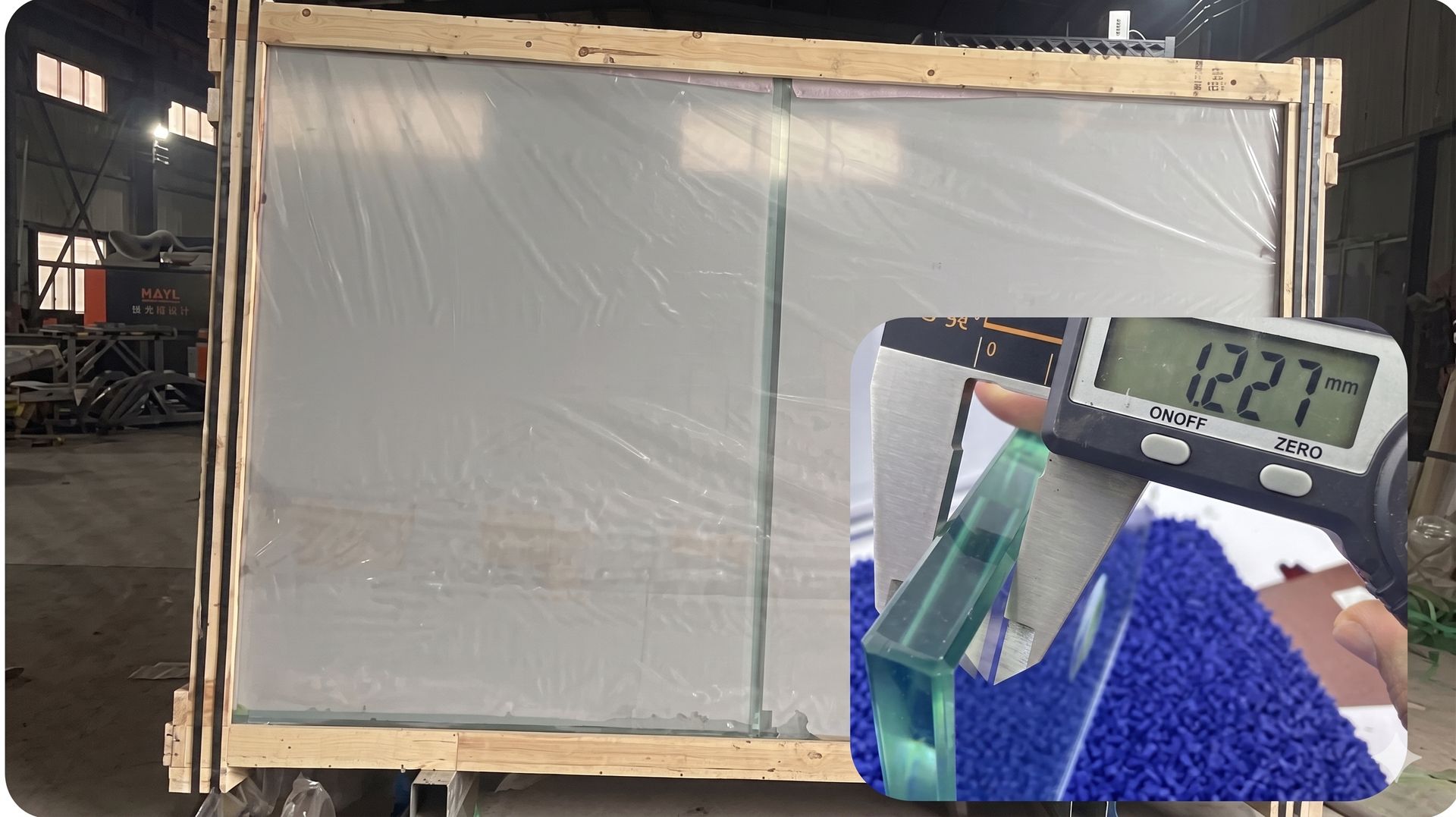
Glass is the most expensive single component of a padel court and the one where factories cut corners. The industry and FIP-homologation standard is 12mm fully tempered (toughened) safety glass, typically conforming to EN 12150. Tempering gives the glass roughly 4-5x the impact strength of annealed glass, and when it does break it shatters into small blunt fragments rather than shards.
What we supply: 12 mm fully tempered walls (EN 12150); laminated 8+8 or 10+10 mm PVB behind entrance walls and premium zones — 6+6 mm is not offered for court walls, and heat-soak (EN 14179-1) is optional, adding about one week. Wall thickness is 3 mm on every Classic and Panoramic post and beam; only the light-duty Economy C model uses an 80×80×2.5 mm profile.
| Glass Parameter | Spec to Request | Verification |
|---|---|---|
| Thickness | 12 mm (±0.3 mm) | Measure with caliper at panel edge |
| Type | Fully tempered (EN 12150) | Ask for heat-soak test certificate |
| Edge finish | Polished / ground edges | No chips; safe for hand contact |
| Panel height | 3.0 m wall height | Full-height panels, not stacked |
| Glass doors | Same 12mm tempered spec | Hinges rated for the panel weight |
Two quality flags to watch: some suppliers quote "10mm glass" for the sides while keeping 12mm only at the ends — demand 12mm throughout. And always request the tempering certificate per batch, not a generic product brochure; the certificate should show the EN 12150 standard, thickness and batch number.
4. What are the metal mesh and fencing specifications?
The mesh completes the enclosure above the walls. FIP rules it tightly because mesh geometry directly affects ball rebound and player safety:
| Mesh Parameter | FIP Requirement | Buyer Check |
|---|---|---|
| Opening (diagonal) | 5.0 - 7.08 cm | Measure with the supplied gauge or tape |
| Wire diameter | 2 - 3 mm recommended (max 4 mm) | Caliper test on delivered rolls |
| Type | Twisted or electro-welded | Welded: all points protected against cuts |
| Tension | Sufficient for uniform ball bounce | No sag or bagging between posts |
| Orientation (square welded) | Horizontal wires inside | Reduces snag risk on horizontal bars |
Mesh is also where anti-corrosion quality shows. Galvanized wire (hot-dip, not just electro-galvanized) is the minimum for outdoor courts; in coastal climates such as Singapore or Australia, specify 80-100 µm zinc coating or stainless-steel fittings at all tension points. Poor mesh coating is the fastest path to rust streaks on the glass below it.
5. What are the playing surface turf, flatness, and drainage specs?
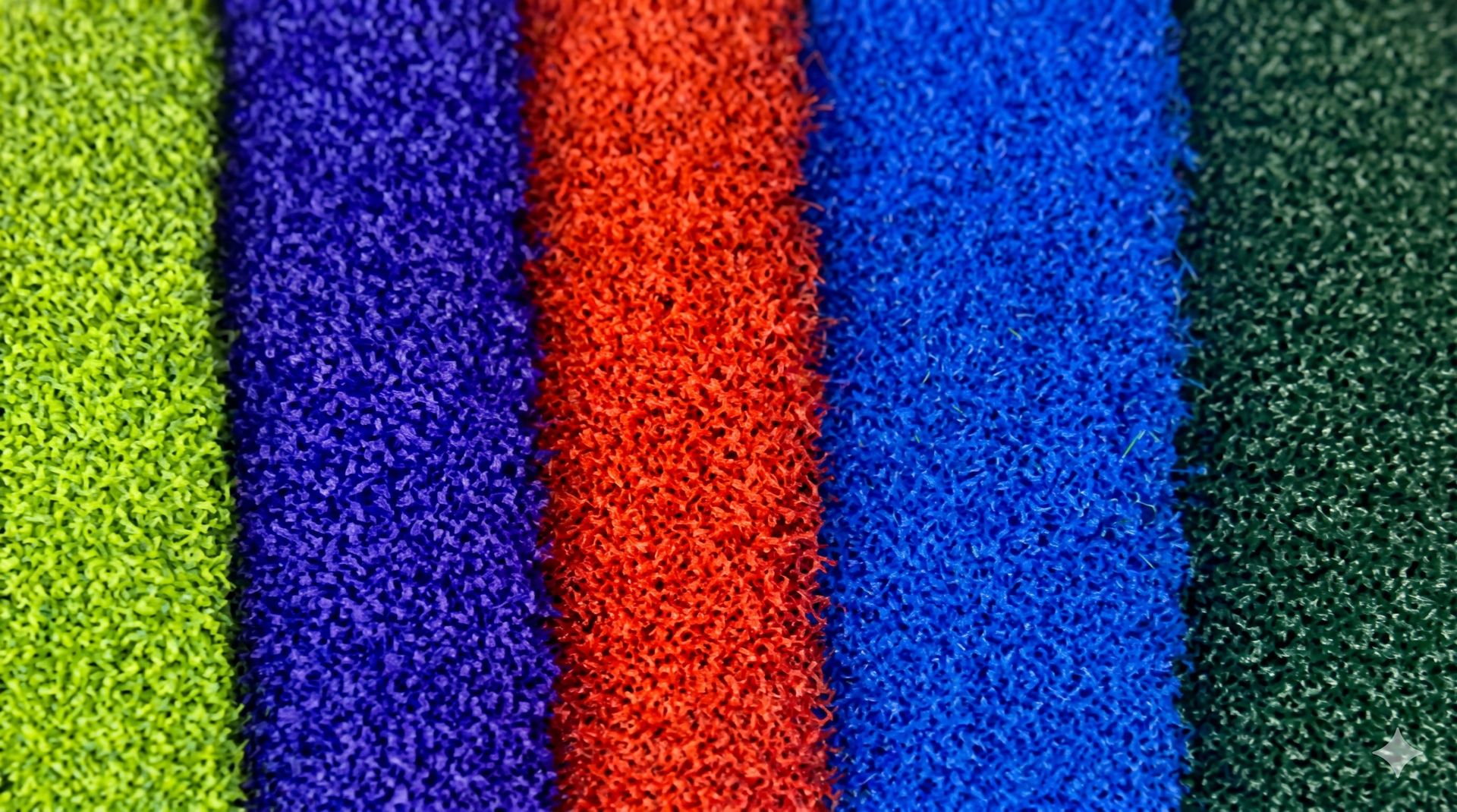
The playing surface does more than feel good underfoot — it determines ball speed, player safety and the court's lifespan. FIP requires a level, uniform surface with differences of less than 3mm measured with a 3m rule (1/1000), and a maximum transverse drainage slope of 1% on non-draining surfaces.
| Surface Parameter | Spec to Request | Notes |
|---|---|---|
| Flatness | < 3 mm per 3 m rule | Test with a straightedge in both directions |
| Drainage slope | Max 1% transverse (without drainage system) | Slopes from centre to outer edges |
| Surface colours | Green, blue or terracotta | Single uniform colour for the whole court |
| Turf type | Artificial grass with infill | Silica sand and/or rubber granulate systems |
| Ball bounce | Consistent, ~80% vertical rebound | Test with a ball drop at several points |
| Impact absorption (force reduction) | ~20% (RF 20%) | FIP-homologated turf values; protects knees |
Infill is where budget turf differs from club turf. Cheaper courts often under-spec the silica sand layer, which makes the court play fast and wear unevenly within 18 months. Specify the turf maker's recommended infill weight (typically 14-18 kg/m² of silica sand for padel turf) and check the sand is spread to a consistent depth across the whole court. Our padel court flooring guide covers turf generations and infill systems in depth.
6. What lux levels and EN 12193 lighting requirements apply?
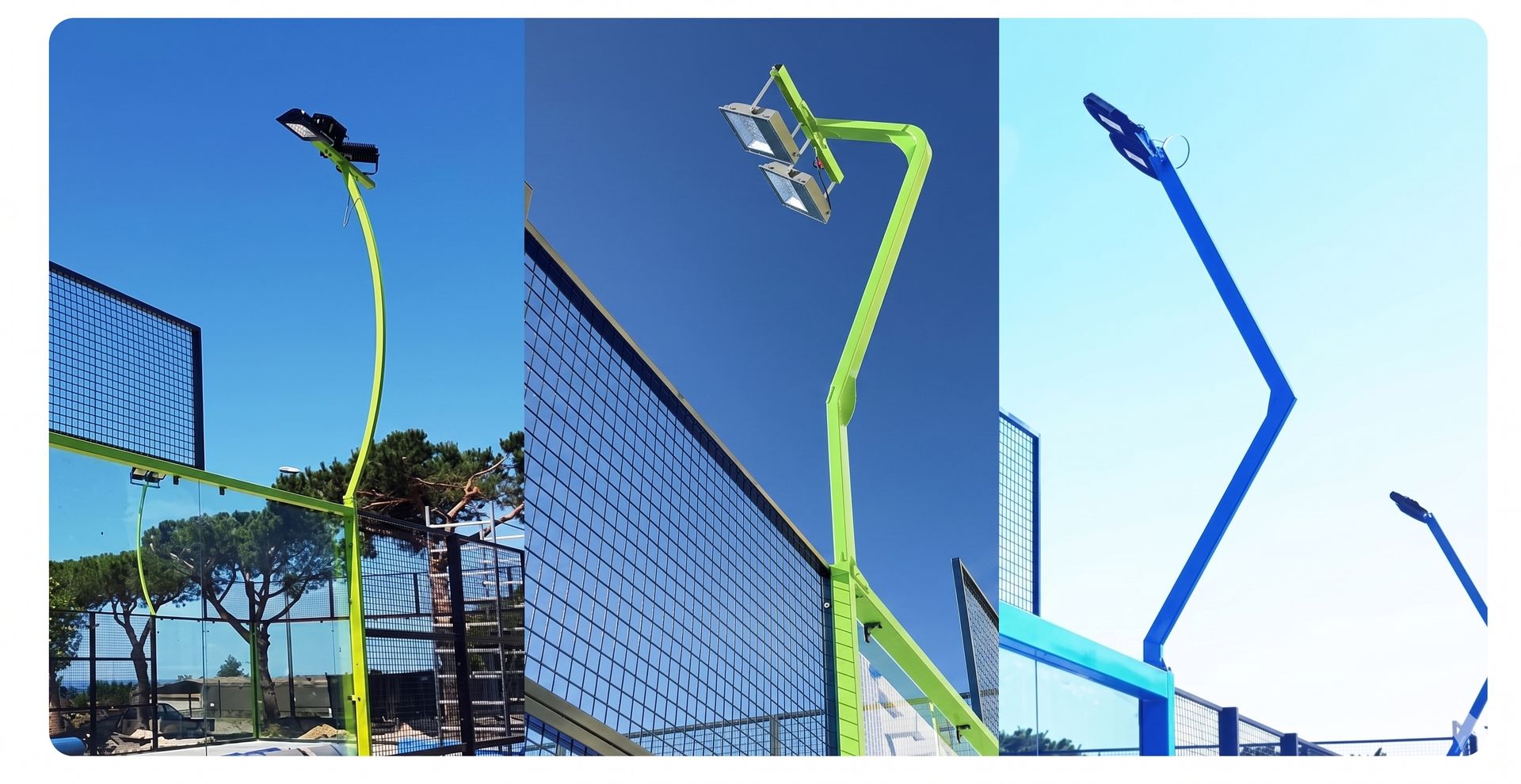
Lighting is governed by EN 12193 (sports facility illumination) with FIP's minimum projector height of 6m from the ground. The lux level you need depends on the play level you are building for — and it is one of the biggest spec gaps between quotes.
| Play Level | Horizontal Illuminance | Typical 2026 Solution |
|---|---|---|
| Recreational / training | 200 lux | LED, ~1.2 kW per court |
| Club / regional play | 300 - 500 lux | LED, ~1.8 kW per court |
| National competition | 500 - 750 lux | LED with higher uniformity optics |
| International / broadcast | 750 - 1,000 lux | Vertical illumination ≥1000 lux for TV |
Beyond lux, specify uniformity (min/max) of at least 0.5-0.7 — bright spots at the net with dark corners is the classic under-engineered LED layout. Request a photometric report (lux plan) from the supplier for your exact court footprint, and make the measured result part of the acceptance checklist below. Poles must sit outside the court and below-projector fixtures must clear 6m minimum.
7. What are the net, post, and access door specifications?
| Component | Specification | Notes |
|---|---|---|
| Net length / height | 10 m long; 0.88 m centre, 0.92 m ends | Tolerance ±0.5 cm |
| Net suspension | Metal cable, max 1 cm diameter | No gap between net and posts |
| Top band | White strip 5.0 - 6.3 cm | May carry advertising, max 11 cm total |
| Posts | Max 1.05 m, rounded edges | External face flush with court limits |
| Access doors (one per side) | 1.05 x 2.00 m min, up to 2.20 x 2.20 m | Handles on the outside, non-protruding |
| Access doors (two per side) | 0.72 x 2.00 m min each | Symmetrical with court centre |
| Post padding | Min 2 cm shock-absorbing protection | On access points and net posts, 3 sides |
Access openings must be protected on three sides (lateral, upper, post) with at least 2cm of cushioning — a safety item that also appears in European club insurance inspections. If the court is for public use, check national accessibility standards for disabled access alongside the FIP opening rules.
8. What are the steel structure and anti-corrosion specifications?
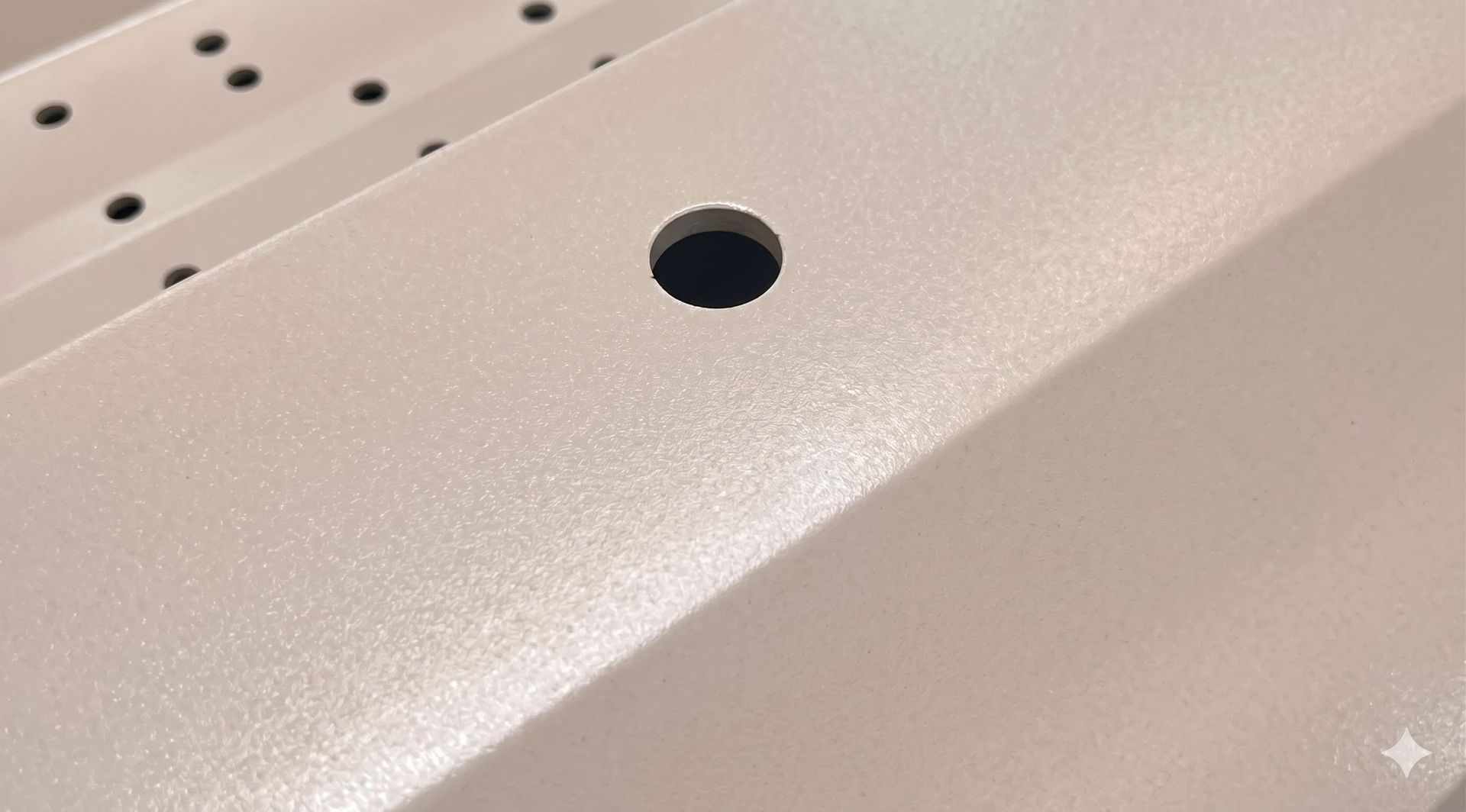
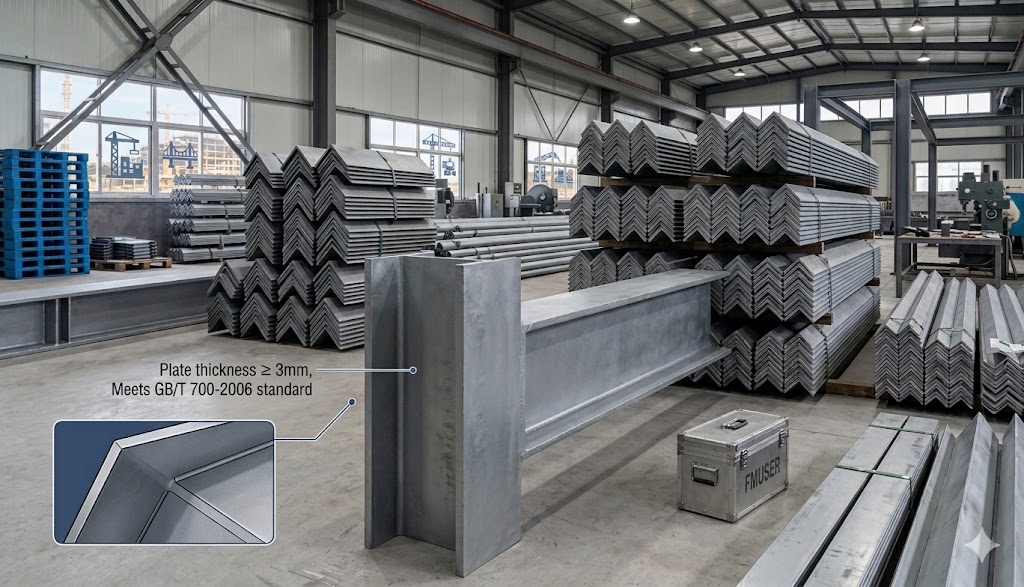
The steel frame carries the glass, mesh and roof loads for 15+ years, and its corrosion protection is the single most important durability spec — especially for coastal or tropical sites. A typical FIP-homologated court uses galvanized steel tube (typically Q235B grade) with hot-dip galvanizing plus a powder coat finish.
| Steel Parameter | Spec to Request | Buyer Check |
|---|---|---|
| Steel grade | Q235B (or local equivalent) | Request material certificate |
| Anti-corrosion | Hot-dip galvanized + powder coat | Uniform zinc coverage, no bare spots |
| Zinc coating | 80 - 100 µm (coastal: higher) | Coating thickness gauge test |
| Fasteners | SUS304 stainless steel | All bolts, hinges, door hardware |
| Welds | Clean, protected after welding | Zinc-rich repair where galvanizing burned off |
| Wind load design | Local wind zone rating | Ask for the structural calculation note |
For rooftop or multi-storey installations, the structural calculation note is not optional — it protects you and your insurer. Ask the factory for the wind-load calculation for your site's wind zone and verify the fastening plan against your building's structural engineer's input. Installation quality is covered in our construction guide.
9. What is included in the factory acceptance checklist?
This is the section to save. Before you release the balance payment or accept delivery, walk this checklist — either at the factory (pre-shipment inspection) or against the delivered documentation set.
| # | Check Item | Acceptance Criteria |
|---|---|---|
| 1 | Court dimensions | 20.0 x 10.0 m interior, ±0.5%; measure at floor level |
| 2 | Line markings | 5 cm lines, service lines at 6.95 m, centre line +20 cm extension |
| 3 | Wall height | 3 m wall + 1 m mesh at ends; side variant per contract |
| 4 | Glass | 12 mm tempered throughout, EN 12150 certificate per batch |
| 5 | Mesh | 5.0 - 7.08 cm openings, 2 - 3 mm wire, no sag |
| 6 | Surface flatness | < 3 mm per 3 m rule in both directions |
| 7 | Drainage | Max 1% transverse slope, water clears the court |
| 8 | Lighting | Lux plan delivered; measured lux meets the contracted level |
| 9 | Net assembly | 10 m net, 0.88 / 0.92 m, cable max 1 cm, no gaps |
| 10 | Doors & padding | Openings per contract, ≥2 cm post cushioning |
| 11 | Steel coating | Hot-dip galvanized, no rust spots, SUS304 fasteners |
| 12 | Documentation | FIP-standard court dimensions and layout drawings, material certs, lux plan, drawings, warranty |
If you are importing from China, a pre-shipment inspection at the factory is usually 10-15% of the court price in travel value but eliminates the costliest failure mode: discovering a spec deviation after the container has landed. At minimum, require time-stamped photos of the 12 checklist points above plus a signed inspection sheet from the manufacturer.
10. Padel Court Specifications FAQ
What are the official padel court dimensions?
The FIP regulation court is a rectangle of 10m wide by 20m long (interior measurements) with a 0.5% tolerance. Service lines sit 6.95m from the net, all lines are 5cm wide, and the net is 0.88m at centre rising to 0.92m at the posts.
How high must padel court walls be?
End walls are 4m total: 3m of wall (glass or solid) plus 1m of metal mesh above. Side enclosures follow FIP variant 1 (stepped walls) or variant 2 (glass sections) with mesh completing the enclosure to 3-4m depending on position.
What thickness is padel court glass?
The standard is 12mm fully tempered safety glass, typically conforming to EN 12150. Demand 12mm on all walls (not just the ends) and request the tempering certificate with batch number.
What lux level does a padel court need?
Per EN 12193: 200 lux for recreational play, 300-500 lux for club and regional competition, 500-750 lux for national events, and 750-1000 lux for international or broadcast play, with a uniformity (min/max) of at least 0.5-0.7.
What are the flatness requirements for a padel court surface?
FIP requires level differences below 3mm measured with a 3m straightedge (1/1000), and a maximum transverse drainage slope of 1% on surfaces without a drainage system.
What should I check before accepting a padel court from the factory?
Walk a 12-point acceptance checklist: interior dimensions, line markings, wall heights, 12mm glass certificates, mesh openings (5-7.08cm), surface flatness, drainage, measured lux levels, net assembly, doors and padding, steel coating and the full documentation set (FIP-standard court dimensions and layout drawings, material certificates, lux plan, drawings, warranty).
These numbers only hold if the supplier actually builds to them: ask for the profile list, the coating thickness and the glass certificates against this specification. Who produces them, and what the plant looks like, is on our padel court factory page.