Home / Pickleball Court Solutions / School & Campus

Pickleball Courts for Schools & Campuses

The fastest sport to teach, the cheapest court to add — provided safety, sightlines and storage are designed in from the start.

8 pupilsper court, rotating
30 × 60 ftminimum footprint
2–3 dayssingle court install
12 hquote turnaround
Quick Answer: A school pickleball court is a standard 20 × 44 ft playing area inside a 30 × 60 ft minimum footprint (34 × 64 ft recommended), with a fence rather than glass — pickleball needs no glass walls, which makes it a lower-risk choice for schools than padel. Indoors, interlocking tiles over the gym floor let courts be set up in the morning and cleared for basketball in the afternoon. One 60 × 120 ft tennis court converts to four pickleball courts, which suits a PE rotation of four games at once. Specify hot-dip galvanised steel with rounded caps, tamper-resistant stainless fasteners, a non-marking surface and 200–300 lux for evening clubs. We quote complete kits, with tender-ready specifications, in about 12 hours.

Quick Summary

This page is written for PE departments, bursars, facility managers and the contractors who build school sports areas. It covers layout and class rotation, the safety specification that differs from a commercial court, gym multi-use and storage, tennis court conversion, after-school clubs and community hire, and the procurement documents schools need. Dimensions follow USA Pickleball court specifications.

Terms used on this page: Multi-use court — a court that converts between sports — peel-and-lay tiles plus removable net posts Sightline — what a supervising teacher can see from the court entrance across the whole playing area PE rotation — groups moving between courts and stations within one lesson

Why pickleball works in a school timetable

No other racket sport gets a whole class rallying in a single lesson.

Students playing on a school court with painted markings
Pickleball suits a PE class because everyone rallies within one lesson — no other racket sport does that.

The teaching argument for pickleball is straightforward: the court is small, the ball is slow, the serve is underarm and the paddle is short. A pupil who has never held a racket can keep a rally going within ten minutes, which means the lesson is spent playing rather than retrieving balls. That is why pickleball has moved into PE curricula faster than any sport in the last twenty years, and why it works with mixed-ability classes where tennis splits a group into players and spectators.

There is a facility argument too. A pickleball court needs about a quarter of a tennis court's land, no glass walls, and a fence that a grounds team can look after. One under-used tennis court becomes four pickleball courts — enough to run a rotation of four games with a class of thirty-two, or to host a house competition at lunchtime without booking anything.

Schools also gain something less obvious: the sport is genuinely lifelong. Pupils who play at school arrive at a community centre or a holiday park able to join a game, and families with a court at home will use it for years. That makes every dollar spent on the courts unusually productive.

Layouts, class capacity and where the courts go

Five settings, and what each one actually supports in a lesson.

Setting Space Pupils at once Setup / takedown
Outdoor permanent courts34 × 64 ft per court8 – 16 per courtpermanent — no setup
Converted tennis courtone 60 × 120 ft court16 – 32permanent — new lines painted
Standard school gymcheck internal dimensions first8 – 16 per courttiles 30–60 min per court; net posts on sockets or wheels
Sports hall (multi-court)2 × 34 × 64 ft bays16 – 32tiles kept on a trolley; most halls store 2–3 courts
Playground / hard play area30 × 60 ft minimum8 per courtpermanent lines; posts fixed or removable

Two planning notes that save schools money. First, measure the hall before promising two courts: a typical 84 × 50 ft gymnasium holds one court with full buffers, or two courts only with reduced buffers along the side walls. Send us the internal dimensions and we will produce a layout to scale before you commit to a scheme. Second, keep the storage route in the plan — a multi-use court only works if the tiles and posts travel from store to hall and back in minutes, on a trolley, by one person.

Court dimensions and line marking

USA Pickleball court specifications, plus the multi-sport line set question.

Element Imperial Metric Notes for this site
Playing court20 × 44 ft6.10 × 13.41 mIdentical for singles and doubles; the part you paint
Non-volley zone (kitchen)7 ft each side2.13 mFull 20 ft width; mark before the surface is sealed
Minimum footprint30 × 60 ft9.14 × 18.29 m5 ft side buffer, 8 ft behind each baseline
Recommended footprint34 × 64 ft10.36 × 19.51 m7 ft sides, 10 ft behind baselines — use it wherever space allows
Tournament footprint40 × 64 ft12.19 × 19.51 mFor centres that will host sanctioned events
Net & posts36 in / 34 in high0.91 m / 0.86 mPosts 22 ft apart, max 3 in diameter, 2 in white top tape

Where a court is shared with netball, basketball or tennis, order the line set as one coordinated scheme rather than adding pickleball lines on top of existing markings. Contrast matters more than colour: pupils have to see the line they are playing to from the far baseline. On multi-sport surfaces we recommend pickleball in one strong colour with the other sports in a contrasting scheme, agreed before painting — a repaint afterwards costs more than the paint.

Safety, supervision and the school specification

Six decisions that make a court appropriate for pupils rather than only for adults.

Item School specification Why
Enclosure10 ft fence with rounded post caps, no glasscontains balls cheaply, no glass handling or breakage risk
Net postsfixed socket posts for permanent courts, wheeled posts for shared hallsno loose ballast; nothing to fall on a pupil
Surfacenon-marking, textured, with a cushioned or tile systemgrip in wet conditions and less shock on young joints
Sightlinescourt entrances positioned so one teacher can see all courtssupervision is a design feature, not a staffing problem
Storagelockable unit or trolley for nets, tiles and brushesprotects equipment, protects the timetable
Lighting200–300 lux, glare-controlled, timer to a fixed curfewsupports after-school clubs without lighting the neighbours

The differences from a commercial court are small but real: no glass, rounded post caps, a non-marking textured surface, and an entrance position that lets one teacher watch every court at once. Two further items are worth writing into the tender. Ask for material and coating certificates (we supply hot-dip galvanising certificates to ISO 1461 with each order, and reports for any glass products used elsewhere on site), and ask for rounded or covered fixings at pupil height — the most common school-court injury is a scrape on a bolt end, not a fall.

Sharing the hall: tiles, storage and changeover time

How a gym becomes two pickleball courts before period one and a basketball hall by period five.

  • Interlocking tiles are the standard solution for gym floors: they need no adhesive, protect the floor surface, and lift without damage when the space changes use.
  • Net posts either drop into floor sockets (fastest, cleanest) or stand on weighted wheeled bases (no sockets needed, slightly slower). Socket posts are worth fitting if the hall is available — the sockets are flush and covered when not in use.
  • Storage on a trolley: a two-court tile set stacks on one trolley that one member of staff can move. Budget a lockable store near the hall, not at the other end of the building.
  • Changeover: allow 30–60 minutes per court for a two-person team. Courts that take longer than that stop being used, whatever the equipment quality.
  • Floor protection: confirm the school's floor-finish requirements before ordering — tile undersides and net bases are specified accordingly.

After-school clubs, house competitions and community hire

The same courts that serve PE can fund their own maintenance.

Schools with courts in place usually run three activities within a term: an after-school club (twice a week, paddles supplied, one member of staff or a parent volunteer), an intra-school league or house competition at lunchtime, and community hire in the evenings or at weekends to a local club. The third is the one that pays.

Two things make evening hire straightforward. Lighting to 200–300 lux with a timer set to an agreed curfew keeps the pitch inside the school's own rules, and a simple booking arrangement — a key holder, a signed usage agreement and a damage reporting line — is enough for most schools. Where a school wants to go further, the same courts support holiday camps, which are among the easiest programmes to fill in the first summer a court opens.

Tender documents, budget cycles and delivery windows

What a school business manager needs from a supplier before the order can be placed.

Cost driver Why it moves the number How to keep it down
Permanent versus multi-usetile systems include storage and a trolley; a permanent court does notchoose tiles only where the hall must convert back to another sport
Court countfencing, lighting and access are shared across courtsconvert a tennis court: four courts on one existing base
Base worksasphalt or concrete base is usually a local contractreuse a sound playground or tennis base — and never lay a court on a failing surface
Fencingextent and height around a school play areacontain the sides facing classrooms, paths and car parks
Lightingwhether evenings are used (clubs, community hire)200–300 lux covers after-school sessions; skip competition levels
Delivery timingschool holiday windows are the practical installation slotorder in spring for a summer holiday install; production is 4–5 weeks

For schools, three documents decide how smoothly the project lands: a technical specification written so it can go straight into a tender or a three-quote comparison; drawings for the base, socket positions and fence layout, so the grounds contractor and the supplier are working to the same plan; and a delivery schedule that matches a holiday window. Tell us the term dates and the holiday period you are targeting — production is 4–5 weeks and freight about 4 weeks, so a summer holiday install is normally ordered in the spring term.

We also provide, on request, reference installations, product data sheets, warranty terms and packing lists for the procurement file, and we will complete a school's own supplier questionnaire rather than asking you to translate our brochure.

What to send us for a same-day quote

Six items, and the quotation arrives with a layout drawing and a specification for your file.

  1. Number of courts, and whether they are permanent or must convert back to another sport.
  2. Indoor hall dimensions, or a plan of the outdoor area with the proposed position marked.
  3. Pupil age range and typical class size — it changes the buffers and the number of courts that make sense.
  4. Existing surface: tennis court, playground, asphalt or bare ground.
  5. Lighting needed for after-school or community use, and any curfew.
  6. The holiday window you want the installation in, and any tender documentation to complete.

Use the quote form or WhatsApp. Both reach the same engineer, and schools get the specification in a format that can go straight into a procurement file.

The factory, the quality checks and the paperwork behind your court

Schools buy on documents: specifications, certificates and a delivery date that fits a holiday. We supply all three.

PeakPadel is the export brand of Shanghai Super Energy Sports Facilities Co., Ltd. We work with partner factories in Hebei and Tianjin: 8 production lines, a 12,000 m² workshop and around 1,500 complete court sets a year, with courts playing in more than 30 countries. For school orders we are usually asked for a tender-ready specification, coating and material certificates, and a delivery window tied to a holiday. Tell us the term dates and we will confirm the schedule in writing.

Documents that travel with an order:

  • Galvanising: hot-dip galvanised to ISO 1461 at 80–100 µm, with the per-batch coating certificate for the steel in your order.
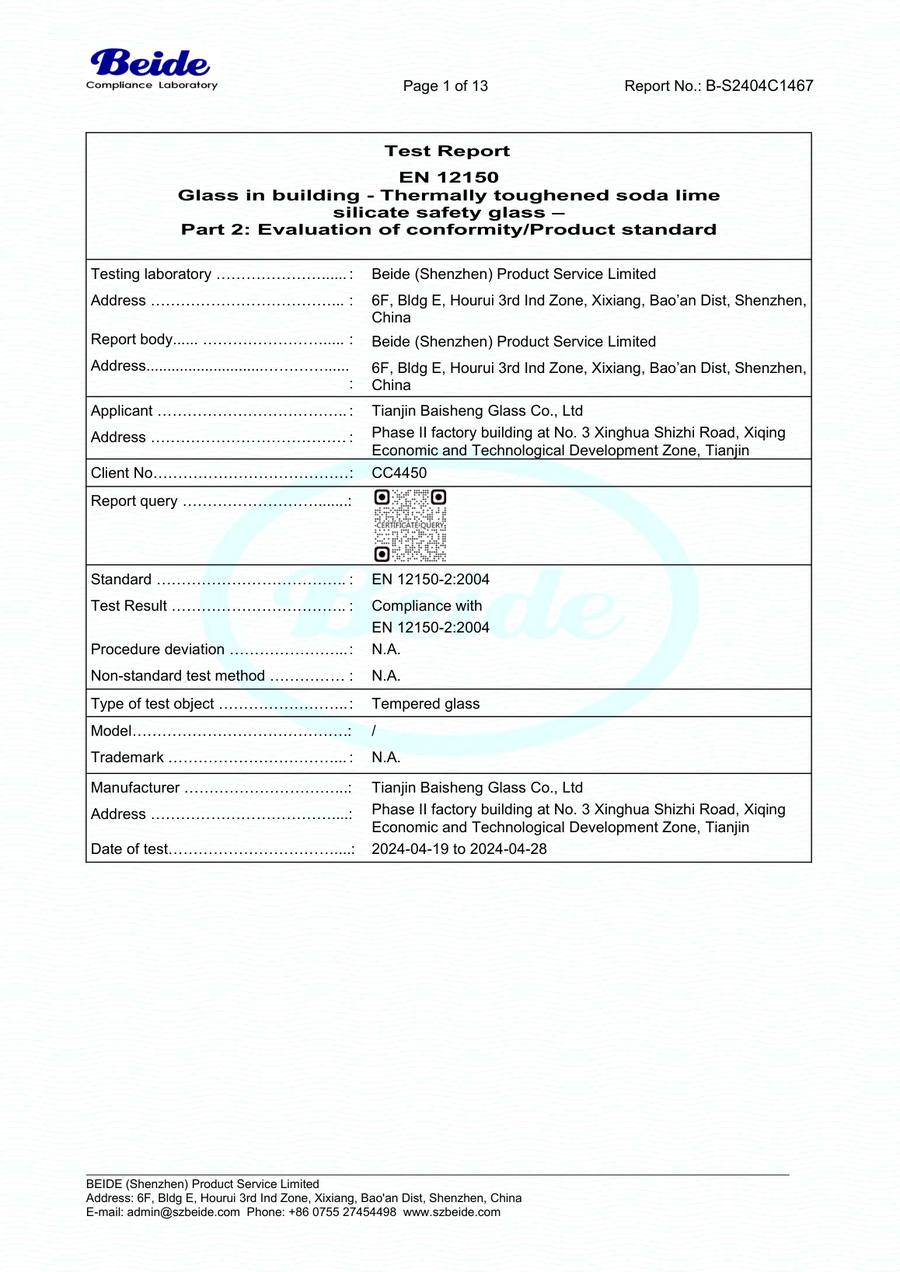
  • Glass: a tempered glass test report to EN 12150-2, with the report number on it — a document, not a logo on a slide.
  • Packing: the packing list is checked against the approved drawing before the container is sealed, and a pre-shipment photo set or video walkthrough of the kit is available on request.
  • Drawings: foundation, net-post socket, fence fixing and drainage details issued for your contractor, so the base is right before the container lands.
  • Lighting: a photometric plan giving lux or footcandle levels and uniformity across the court, not a fixture count.
  • Warranty: written terms for the court system against manufacturing defects and corrosion, confirmed per project in the quotation.
12 mm tempered glass test report EN 12150-2:2004, report B-S2404C1467 page 1
12 mm tempered glass — EN 12150-2:2004 test report B-S2404C1467, page 1.
Reports are issued per glass batch. Ask for the one that matches your order, along with the ISO 1461 galvanising certificate for the steel in the same shipment — if a supplier hesitates on those two documents, that is your answer.
Open the full-size report ↗

School pickleball court questions

Eight comfortably for skills work — four per side — and up to sixteen on a court in short games with a rotation. A converted tennis court gives four pickleball courts, which suits a class of thirty-two in groups with a teacher moving between courts.

No. Pickleball is played entirely within the court, so the enclosure only needs to contain balls — a 10 ft fence with rounded caps is typical. That is one reason pickleball is the lower-risk racket sport for a school site: no glass to break, handle or replace.

Yes. Interlocking tiles need no adhesive, protect the hall floor and can be lifted onto a trolley when the hall returns to basketball or assemblies. Allow 30–60 minutes per court for a two-person changeover; net posts either drop into floor sockets or stand on weighted wheeled bases.

Measure first. A typical 84 × 50 ft gymnasium holds one court with full buffers, or two courts only with reduced buffers along the side walls. Send the internal dimensions and we will send a to-scale layout before you commit to a scheme.

200–300 lux with glare-controlled optics covers after-school clubs, and a timer set to an agreed curfew keeps evening use inside the school's own rules. That is usually enough for community hire as well; competition lighting is only needed if you host sanctioned events.

Order in the spring term. Production takes 4–5 weeks and ocean freight about 4 weeks, and the base works are usually the longest single item. Sending us the exact holiday window lets us confirm in writing whether the date holds before you place the order.

Send the hall dimensions or site plan — get a school court quotation in 12 hours

Tell us the court count, whether the courts must pack away, and the holiday window you are working to. You will receive a layout drawing, a tender-ready specification and a cost breakdown.

Get a Quote → Chat on WhatsApp

Prefer an instant answer? Ask the AI assistant at the bottom-right.