Home / Pickleball Court Solutions / High-Altitude & Mountain

High-Altitude & Mountain Pickleball Courts

Where UV is stronger, the ground freezes, and the ball flies further: a court specification built for elevation rather than adapted to it.

+10 %UV per 1,000 m
Frost linesets foundation depth
300–500 luxevening play
12 hquote turnaround
Quick Answer: A high-altitude pickleball court is a standard 20 × 44 ft playing area in a 30 × 60 ft minimum footprint (34 × 64 ft recommended), specified for four conditions that lowland sites never see: stronger UV (roughly 10 % more per 1,000 m of elevation, unmoderated by haze), freeze–thaw cycles that destroy a poorly drained base, snow and wind loads on fencing, and thinner air that makes the ball fly faster and further. Specify UV-stable surface pigments, a base designed to the local frost depth with drainage that never holds water, galvanised steel to ISO 1461 with stainless fasteners, and wind-rated posts. We quote complete kits with drawings for your engineer in about 12 hours.

Quick Summary

This page is written for mountain resorts, ski-town municipalities, alpine clubs and high-plateau developments. It covers UV and surface degradation, freeze–thaw and base design, frost depth, snow and wind loads, how altitude changes the game itself, lighting for short winter days, and the maintenance routine for a court that spends part of the year under snow. Dimensions follow USA Pickleball court specifications.

Terms used on this page: Frost depth — how deep the ground freezes locally — it sets the required foundation depth Freeze–thaw cycle — repeated freezing and thawing of water in the base, which lifts and cracks surfaces Air density — thinner at altitude, so a pickleball flies faster and further for the same stroke

Courts that work at elevation

The mountain season is short, the demand is concentrated, and the environment punishes every shortcut.

Court surrounded by mountains at high altitude with clean painted lines
At altitude the light is harsh, the ball flies further and the ground moves with the seasons — three things a sea-level court never meets.

High-altitude destinations — ski towns, mountain resorts, plateau cities above 1,500 m — have a pickleball problem that is the opposite of a lowland one. The playing season is compressed, so demand arrives in a rush: courts are busy in the morning, full at lunch and used under lights into the evening. A court that would be an amenity at sea level becomes a revenue line here, because there is nothing else to do in the shoulder season and guests stay for a week.

The environment, though, is unforgiving. UV is stronger, the ground freezes and thaws, snow sits on whatever is not cleared, and wind on an exposed slope can be severe. Most failures on mountain courts trace back to one of two decisions: a base designed for somewhere else, and a surface chosen for its price rather than its UV and temperature rating.

There is also a playing consideration that surprises players and designers alike. The air is thinner, so a hollow ball meets less resistance: shots travel further, rallies speed up, and a court that felt generous at sea level feels tight here. Where the site allows, take the larger buffers and give players room.

UV, frost, snow and thin air

Six conditions, what each one does, and the specification that answers it.

Condition What it does to a court Specification response
High UVchalks surface pigments and fades lines quickly; degrades low-grade plasticsUV-stable surface systems, UV-stabilised screens, quality net and paddle materials
Freeze–thawlifts and cracks a base that holds water; opens joints in fencesbase designed to frost depth, positive drainage, flexible jointing
Snow loadloads fences and nets; melt water saturates the base in springwind- and snow-rated posts, removal plan before the season, drainage sized for rapid melt
Windstronger and more constant at elevation, especially on exposed slopespost sections and base plates sized to your design wind speed
Thin airthe ball flies faster and further; rallies speed up; players tire soonerlarger run-off where the site allows, shade and water in the rest area
Short seasonhigh demand in a compressed window, including long evening sessionslighting to 300–500 lux with reliable cold-rated luminaires

Of these, the two that decide whether a court survives are drainage and frost depth. Water that sits in a base in autumn freezes, lifts and cracks whatever is above it — a process that repeats every year and cannot be fixed from the surface. The base must be designed to the local frost depth with positive drainage, and the surface must sit above the surrounding ground. This is the one part of a mountain project where a cheap decision is guaranteed to be an expensive one.

Dimensions and the altitude adjustment

USA Pickleball court specifications, plus why the run-off matters more up here.

Element Imperial Metric Notes for this site
Playing court20 × 44 ft6.10 × 13.41 mIdentical for singles and doubles; the part you paint
Non-volley zone (kitchen)7 ft each side2.13 mFull 20 ft width; mark before the surface is sealed
Minimum footprint30 × 60 ft9.14 × 18.29 m5 ft side buffer, 8 ft behind each baseline
Recommended footprint34 × 64 ft10.36 × 19.51 m7 ft sides, 10 ft behind baselines — use it wherever space allows
Tournament footprint40 × 64 ft12.19 × 19.51 mFor centres that will host sanctioned events
Net & posts36 in / 34 in high0.91 m / 0.86 mPosts 22 ft apart, max 3 in diameter, 2 in white top tape

The playing area does not change with altitude, but the recommended footprint does. Because the ball flies further and faster in thin air, we recommend the 34 × 64 ft footprint as a minimum on high-altitude sites and 40 × 64 ft where the land allows — particularly for venues that will host coaching or competition. The extra run-off is where players actually chase the ball at 2,000 m.

Base design for frost and snowmelt

The four layers that decide whether a mountain court is still flat in five years.

  • Sub-base to frost depth: free-draining, compacted granular material taken below the local frost line, so freezing does not heave the court. Your engineer's local knowledge sets the depth; we design the court layers above it.
  • Drainage that cannot hold water: falls away from play on every side and outlets sized for spring melt, not average rain. On a mountain site, the failure month is April, not August.
  • Edge restraint: a sealed or restrained edge stops the surface moving as the base beneath it expands and contracts through the year.
  • Surface system rated for the range: acrylic systems and tiles both work at altitude when they are specified for the local temperature swing and UV. Generic systems chalk and crack; the rating matters more than the brand.

Where the court is used in winter as well, an interlocking tile system has a practical advantage: individual tiles can be lifted and replaced if a section is damaged by ice or a snow-clearing machine, without re-doing the whole surface.

Snow, wind and the closed season

How to protect a court you cannot play on for four months.

  • Removal plan: clear snow with a plastic-bladed scraper, never a metal edge. On tiles, clear early rather than letting a heavy pack sit for weeks.
  • Fencing: posts sized for snow accumulation as well as wind, and screens taken down or slackened before the winter on exposed sites to reduce load.
  • Net systems: nets removed and stored indoors; posts left in place with sockets capped. A net left up all winter is a net you replace in spring.
  • Wind on exposed slopes: give us the design wind speed; on ridge sites we recommend pressure-equalising screens and shorter fence runs on the exposed side.
  • Spring inspection: check the base for heave, the fence fixings for corrosion where salt or grit has been used, and line contrast before the season opens.

Lighting for short days and long evenings

Cold-rated luminaires, downward optics, and levels matched to club play.

At altitude the evening arrives early for much of the year, so lighting is what turns a court from a daytime amenity into a bookable evening facility. The levels we design to: 300 lux for social and family play, 300–500 lux for club sessions and coaching, and 500 lux and above only for venues that will host sanctioned events.

Two specification details matter in the mountains. First, cold-rated luminaires and drivers — ordinary fittings lose output and shorten their life at low temperatures. Second, downward, shielded optics: on dark evenings at a mountain site, unshielded light produces glare against snow and haze, and light spill up a slope is noticed by every neighbour. Fit a timer to an agreed switch-off time and, if the court sits near accommodation, put the poles on the far side. Our court lighting page covers pole layouts and photometric planning; one is issued with every quotation.

What drives the cost of a mountain court

Seven variables, from frost depth to the delivery window.

Cost driver Why it moves the number How to keep it down
Base design for frostdeeper sub-base and drainage than a lowland courtdo it once, correctly — a base rebuilt after two winters costs more than the court
Drainagesnowmelt arrives fast and in volumesize outlets for spring melt, not average rainfall
Surface systemUV-stable pigments and cold-flexible systems cost morechoose a system rated for the local temperature range, not a generic one
Snow and wind ratingpost sections, fencing and fixings sized for the local loadsgive us the local snow and wind loads at enquiry and it is priced once
Season lengthwhether the court is used in winter or covereda removal and cover routine extends surface life more cheaply than a heavier surface
Freight and accessmountain roads, seasonal closures, limited delivery windowsschedule delivery outside the closed season; tell us the access constraints early
Lightingcold-rated luminaires and longer evening use300 lux covers club evenings; specify higher only for events

Two of these items are outside our scope and usually the largest on the project: the base works and the access route. Send us the site plan, the elevation, the local frost depth if your engineer has it, and the access constraints, and you will have a specification, drawings and a line-by-line quotation in about 12 hours. For the wider budget picture — base, tax, and the local share of the works — see our court cost guide.

How the game changes up here

Faster ball, shorter rallies, quicker fatigue — and what coaches do about it.

  • The ball flies further. Thinner air means less drag, so the same stroke sends the ball deeper. Coaches working at altitude teach players to shorten their swing, not to hit harder.
  • Rallies speed up. Reaction time is compressed, which is why larger run-off and a consistent, contrasty surface matter more here than at sea level.
  • Players tire sooner. Acclimatisation takes days; shade, water within the court area, and shorter sessions make visiting players much happier.
  • Sun is a real hazard. With stronger UV and often less shade, plan a shaded rest area and put it in the brief — guests will use it every session.
  • Ball choice matters. Keep a small stock of outdoor balls; some coaches switch to a softer ball for junior and beginner sessions at high elevation.

None of this changes the court dimensions. It changes the site plan around them, which is why we ask for elevation and aspect with every mountain enquiry.

What to send us for a same-day quote

Seven items, and the quotation arrives with drawings for your engineer.

  1. Site plan or aerial image with the court position marked, and the elevation in metres.
  2. Aspect and exposure — which direction the slope faces, and whether the site is windy.
  3. Local frost depth and any snow or wind load figures from your engineer.
  4. Whether the court will be used in winter, or closed and covered.
  5. Number of courts and whether events are planned.
  6. Lighting requirement for evening club sessions.
  7. Access constraints and the delivery window — mountain roads and seasonal closures change the schedule.

Use the quote form or WhatsApp. Mountain projects are specified case by case; the elevation and frost information is what makes the quotation accurate rather than approximate.

The factory, the quality checks and the paperwork behind your court

Mountain projects are approved against local loads and certificates. We issue both with the quotation.

PeakPadel is the export brand of Shanghai Super Energy Sports Facilities Co., Ltd. We work with partner factories in Hebei and Tianjin: 8 production lines, a 12,000 m² workshop and around 1,500 complete court sets a year, with courts playing in more than 30 countries. For high-altitude orders we are usually asked for coating certificates, the surface system's UV and temperature ratings, and drawings that show the base build-up to frost depth. All three are supplied with the quotation.

Documents that travel with an order:

  • Galvanising: hot-dip galvanised to ISO 1461 at 80–100 µm, with the per-batch coating certificate for the steel in your order.
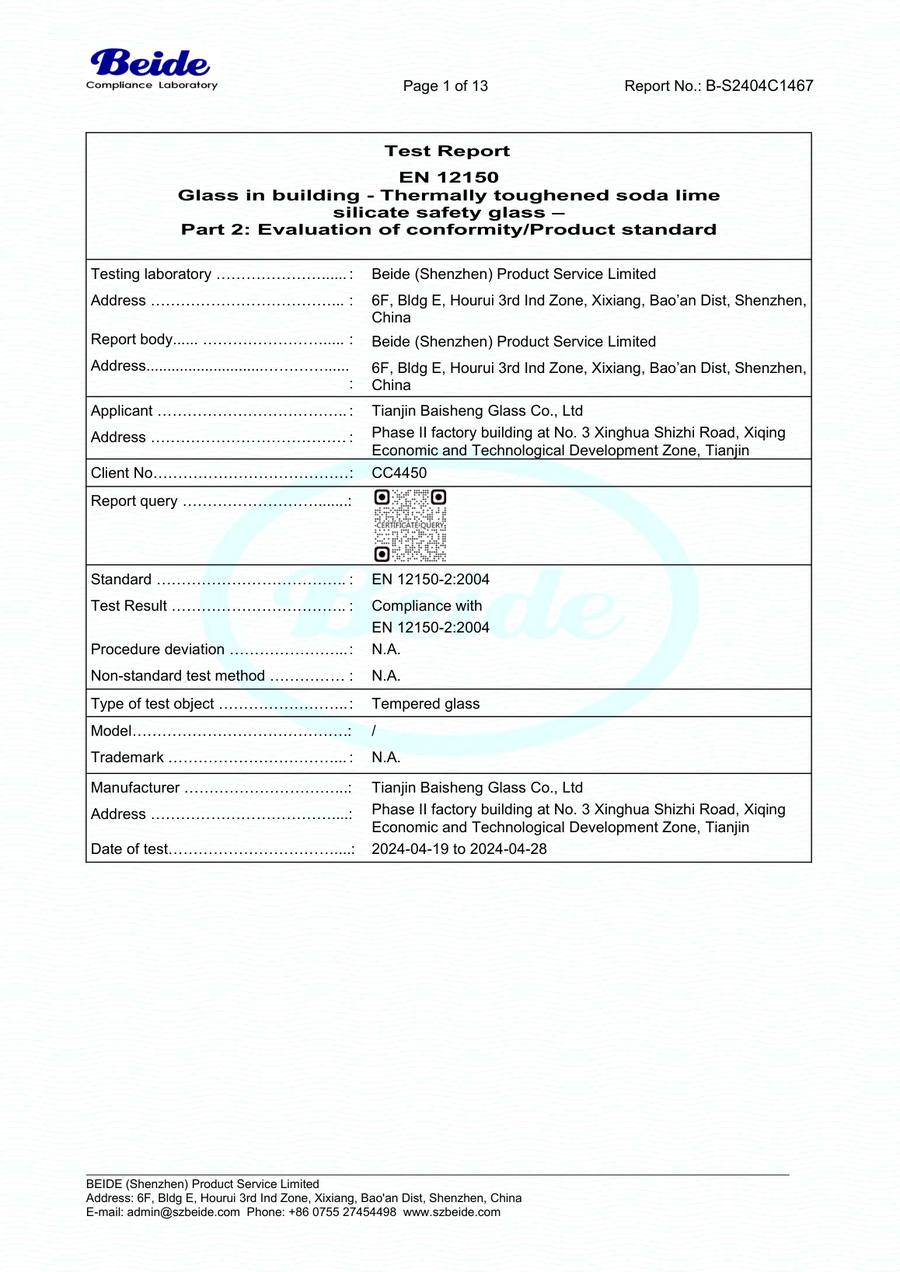
  • Glass: a tempered glass test report to EN 12150-2, with the report number on it — a document, not a logo on a slide.
  • Packing: the packing list is checked against the approved drawing before the container is sealed, and a pre-shipment photo set or video walkthrough of the kit is available on request.
  • Drawings: foundation, net-post socket, fence fixing and drainage details issued for your contractor, so the base is right before the container lands.
  • Lighting: a photometric plan giving lux or footcandle levels and uniformity across the court, not a fixture count.
  • Warranty: written terms for the court system against manufacturing defects and corrosion, confirmed per project in the quotation.
12 mm tempered glass test report EN 12150-2:2004, report B-S2404C1467 page 1
12 mm tempered glass — EN 12150-2:2004 test report B-S2404C1467, page 1.
Reports are issued per glass batch. Ask for the one that matches your order, along with the ISO 1461 galvanising certificate for the steel in the same shipment — if a supplier hesitates on those two documents, that is your answer.
Open the full-size report ↗

High-altitude & mountain court questions

No — the official court is 20 × 44 ft at any elevation. What changes is the recommended footprint: because the ball flies further in thinner air, we recommend 34 × 64 ft as a minimum on high-altitude sites and 40 × 64 ft where land allows, especially for coaching and competition.

Design the base to the local frost depth with free-draining material, positive falls away from play on every side, and outlets sized for spring snowmelt rather than average rainfall. Water held in a base in autumn is what lifts and cracks a court in winter.

Both acrylic systems and interlocking tiles work when specified for the local UV and temperature range. Tiles have a practical advantage where a snow-clearing machine may damage a section: individual tiles are lifted and replaced without re-doing the whole surface.

Sometimes, with a clear plan: plastic-bladed snow clearing, nets stored indoors, and screens slackened or removed on exposed sites. Many mountain venues close the courts for the season and use the indoor alternative — a tiled court in a hall or converted space.

Yes. Thinner air means less drag, so the same stroke sends the ball further and rallies speed up. Coaches working above 1,500 m typically shorten the swing rather than hitting harder, and keep softer balls for junior and beginner sessions.

300 lux for social play and 300–500 lux for club evenings, with cold-rated luminaires and downward, shielded optics — unshielded light produces glare against snow and haze. Fit a timer to an agreed switch-off time, particularly where accommodation is nearby.

Send the elevation and site details — get a mountain court quotation in 12 hours

Tell us the elevation, aspect, frost depth if known, and whether the court is used in winter. You will receive a specification, base build-up drawings, a bill of materials and a cost breakdown.

Get a Quote → Chat on WhatsApp

Prefer an instant answer? Ask the AI assistant at the bottom-right.