Home / Pickleball Court Solutions / Seaside & Beach

Seaside & Beachfront Pickleball Courts

Salt, wind, sand and sun: the four things that destroy an ordinary court on the coast — and the specification that survives them.

316stainless fasteners
80–100 µmhot-dip galvanising
10–15 ftnetting on exposed sides
12 hquote turnaround
Quick Answer: A seaside pickleball court is dimensionally standard — 20 × 44 ft of playing area inside a 30 × 60 ft minimum footprint — but the specification is not: coastal sites need hot-dip galvanised steel to ISO 1461 (80–100 µm), 316 stainless fasteners, wind-rated posts sized to your design wind speed, pressure-equalised wind screens, ball containment netting on the exposed sides, and a surface that drains freely and does not trap blowing sand. Sand ingress is the enemy of every surface, so a windward screen plus a firm drainage edge and a hard brush do more for surface life than any coating. We supply per-batch coating certificates and quote complete coastal kits in about 12 hours.

Quick Summary

This page is written for beach resorts, coastal municipalities, marina operators, beach clubs and the contractors who build on the shoreline. It covers what salt air does to ordinary steel, how to size fencing for coastal wind, sand control, drainage and elevation, surface and UV choices, lighting on an exposed site, and the maintenance routine that keeps a coastal court sound. Dimensions follow USA Pickleball court specifications.

Terms used on this page: Splash zone — the strip near the shoreline where wind-driven salt spray reaches everything — the hardest environment Pressure-equalising screen — a wind screen with a gap or perforation so it does not act as a sail Sand ingress — sand blown onto and into a surface, which abrades lines and blocks drainage

Why coastal courts are worth doing properly

A seaside court is the most photographed amenity on the property — and the one that punishes cost-cutting fastest.

Pickleball courts near the water with the sea behind them
On the coast, the ball leaves the court in wind before it leaves in play — containment and screening are part of the game.

Courts by the sea attract players in the hours when nothing else is happening: early morning before the beach fills, and late afternoon when the light is at its best. For a beach resort, a marina or a coastal town, that is valuable land use, and it produces the photographs that sell the property for years.

The catch is that the shoreline is the harshest environment any court will ever be built in. Salt spray reaches everything within wind range of the surf, UV is unmoderated by shade or buildings, wind is stronger and more constant than inland, and sand gets into places no other site has. A court specified for a city park will look tired here within two seasons, and the failures start where you cannot see them: on fasteners, at welds and inside posts.

Three decisions, taken at the specification stage, decide whether a coastal court is still sound in year ten. Corrosion class: hot-dip galvanising to ISO 1461 with 316 stainless fasteners. Wind: posts and fences sized to your design wind speed, with screens that let pressure through rather than acting as sails. Sand and drainage: a surface you can brush clear, and a court that sits above the surrounding ground with water falling away from play.

What salt air does to an ordinary court

Six items, and what actually happens to each one on a coastal site.

Item Coastal specification Why it fails otherwise
Steel posts and framehot-dip galvanised to ISO 1461, 80–100 µm, with the per-batch certificatepainted or thinly coated steel blisters within two seasons near the sea
Fasteners316 stainless throughoutgalvanised bolts are the first failure point in salt air — and the hardest to replace
Net postsgalvanised with stainless fittings; aluminium where weight matterschrome-plated or powder-coated posts rust at the weld and the insert
Fence mesh and screeninggalvanised mesh, UV-stabilised screen, wind-rated postslow-grade mesh sags and the screen tears in the first winter storm
SurfaceUV-stable acrylic or marine-grade tiles with a sealed edgecheap paint chalks under UV and lines fade within a year
Luminaires and cablingmarine-grade IP-rated fittings, sealed glands, stainless bracketssalt corrodes domestic fittings from the inside out

The most common coastal mistake is not the fence — it is the fastener. A court built with galvanised bolts on a galvanised frame looks identical to a correct one on day one and shows orange streaks at every joint within a year. Because fasteners are the hardest component to replace after installation, this is the specification line worth arguing about with any supplier.

The second most common mistake is treating distance from the sea as a single number. Corrosion severity falls with distance from the surf line and rises with exposure to onshore wind, so two sites 500 m apart can need different specifications. Tell us the distance to the water, the prevailing wind direction and whether the site takes direct spray — we will set the class from that rather than from a default.

Dimensions and the coastal buffers

USA Pickleball court specifications — with more room recommended behind the baselines on an exposed site.

Element Imperial Metric Notes for this site
Playing court20 × 44 ft6.10 × 13.41 mIdentical for singles and doubles; the part you paint
Non-volley zone (kitchen)7 ft each side2.13 mFull 20 ft width; mark before the surface is sealed
Minimum footprint30 × 60 ft9.14 × 18.29 m5 ft side buffer, 8 ft behind each baseline
Recommended footprint34 × 64 ft10.36 × 19.51 m7 ft sides, 10 ft behind baselines — use it wherever space allows
Tournament footprint40 × 64 ft12.19 × 19.51 mFor centres that will host sanctioned events
Net & posts36 in / 34 in high0.91 m / 0.86 mPosts 22 ft apart, max 3 in diameter, 2 in white top tape

On an exposed coastline we recommend taking the largest buffer the site allows — 40 × 64 ft where possible — for a practical reason: in wind, players chase balls further and faster, and a court with a wide run-off is safer than one where the baseline sits close to a fence, a rail, or the edge of a terrace. If the court is on a raised terrace or a promenade, put a guard rail outside the run-off area on any side with a drop.

Wind: fencing, screens and the sail problem

A wind screen turns a fence into a sail. The fix is sizing plus pressure relief, not a thicker post alone.

Coastal wind does two things to a court. It moves the ball — a hollow pickleball is heavily affected, so a screen on the windward side makes the court playable on days that would otherwise be lost. And it loads the structure: a solid screen on a 10 ft fence in a 25 m/s gust produces a force that an unspecified post will eventually fail under.

  • Size to the design wind speed you give us, not a default — coastal codes vary enormously and it changes post sections and base plates.
  • Pressure-equalise screens with a gap at the base or a perforated section, so wind passes through rather than filling the screen.
  • Contain with netting above the fence on the sides facing water, roads or neighbouring property — 10–15 ft — because a ball lost to the sea ends the session.
  • Inspect after every storm season: screen fixings, post bases and mesh tension. Ten minutes twice a year prevents the failure that closes the court in July.

Sand, drainage and keeping the surface playable

Blowing sand abrades lines and blocks drains. It is a design problem before it is a maintenance problem.

  • Windward screen first: stopping sand at the boundary is cheaper than removing it from the court every week.
  • Firm drainage edge: a sealed or paved edge strip stops sand migrating into the surface and the outlets.
  • Surface selection: on a very sandy site, tiles are easier to brush and lift clear than a bonded acrylic system, and individual damaged tiles can be replaced.
  • Raise the court: build the playing area above the surrounding ground level, with falls away from play on every side. Coastal rain arrives in short, heavy bursts and standing water is the fastest way to lose a surface.
  • Shade and irrigation: a shade sail over the player rest area, and irrigation that does not overspray onto the court, both protect the surface and the players.

Lighting on an exposed coast

Marine-grade fittings, sealed cable entries, and a level matched to how the court will really be used.

Coastal lighting fails in the fittings, not the luminaires: salt gets into cable glands and bracket joints, and corrosion starts where nobody looks. Use marine-grade IP-rated fittings with stainless brackets and sealed glands, and keep cable runs out of standing water.

On levels, the honest guide: 300 lux is enough for social and family play, 300–500 lux for club sessions and coaching, and 500 lux and above only if the venue will host sanctioned events. On a beach site, avoid over-lighting — unshielded light bounces off sand haze and produces glare. Downward optics, aimed along the court, with a timer set to an agreed switch-off time, keep both the players and the neighbours comfortable. Our court lighting page explains pole layouts and what a photometric plan should contain; one is issued with every quotation.

The coastal maintenance routine

Fifteen minutes a week and one inspection a year is the whole programme — if the specification is right.

  • Weekly: brush the playing area to clear sand, especially at the upwind corner, and check the drainage outlets are clear.
  • Monthly: hose the court and fence with fresh water after a period of onshore wind; check net tension.
  • After storm season: inspect post bases, screen fixings, mesh tension and any stainless fittings. Touch up any site damage to galvanising with a zinc-rich repair coating.
  • Annually: check all fasteners are tight, replace any that show corrosion, and confirm line contrast under the glare of a low sun.
  • Keep a spares box: a net, a set of stainless fasteners, a screen section and a couple of tiles. On the coast, a small fault that waits three weeks for a part becomes a bigger one.

What to send us for a same-day quote

Six items, and the quotation comes back with a coastal specification and drawings.

Cost driver Why it moves the number How to keep it down
Corrosion class316 stainless and heavier galvanising cost more than inland equivalentsspecify correctly once — a rusted fence replaced in year four costs more than either
Wind ratingpost sections, base plates and foundations sized to wind speedgive us the design wind speed at enquiry and it is priced once, correctly
Screening and nettinghow many sides face wind, sand and open waterscreen the windward and exposed sides; leave sheltered sides open
Surface choiceacrylic versus tiles, sealed edges, UV-stable pigmentstiles where sand blows hard and can be brushed clear; acrylic on sheltered sites
Drainagecoastal rainfall intensity and storm levelsraise the court above surrounding ground; falls away from play in every direction
Freightcontainers, port handling, and access along a beach roadorder complete kits; coastal access is the line item that surprises clients most
Maintenancea real, budgeted routine on the coastbudget a brush, a freshwater wash-down and an annual fastener check

  1. Site plan or photograph with the proposed court position, and the distance to the water.
  2. Prevailing wind direction and whether the site takes direct spray.
  3. Design wind speed, if your engineer has it.
  4. Base situation: existing slab, promenade, deck, sand or bare ground.
  5. Number of courts and whether the site will host events.
  6. Any environmental or permitting constraints on the build line.

Use the quote form or WhatsApp. Coastal projects are specified case by case — the more you tell us about the exposure, the more accurate the quotation will be.

The factory, the quality checks and the paperwork behind your court

Coastal projects are signed on corrosion documents and wind calculations. Both come with our quotation.

PeakPadel is the export brand of Shanghai Super Energy Sports Facilities Co., Ltd. We work with partner factories in Hebei and Tianjin: 8 production lines, a 12,000 m² workshop and around 1,500 complete court sets a year, with courts playing in more than 30 countries. For seaside orders we are usually asked for the galvanising certificate for the actual batch of steel, the stainless grade of every fastener, and the wind calculation behind the post sections. All three are supplied in writing.

Documents that travel with an order:

  • Galvanising: hot-dip galvanised to ISO 1461 at 80–100 µm, with the per-batch coating certificate for the steel in your order.
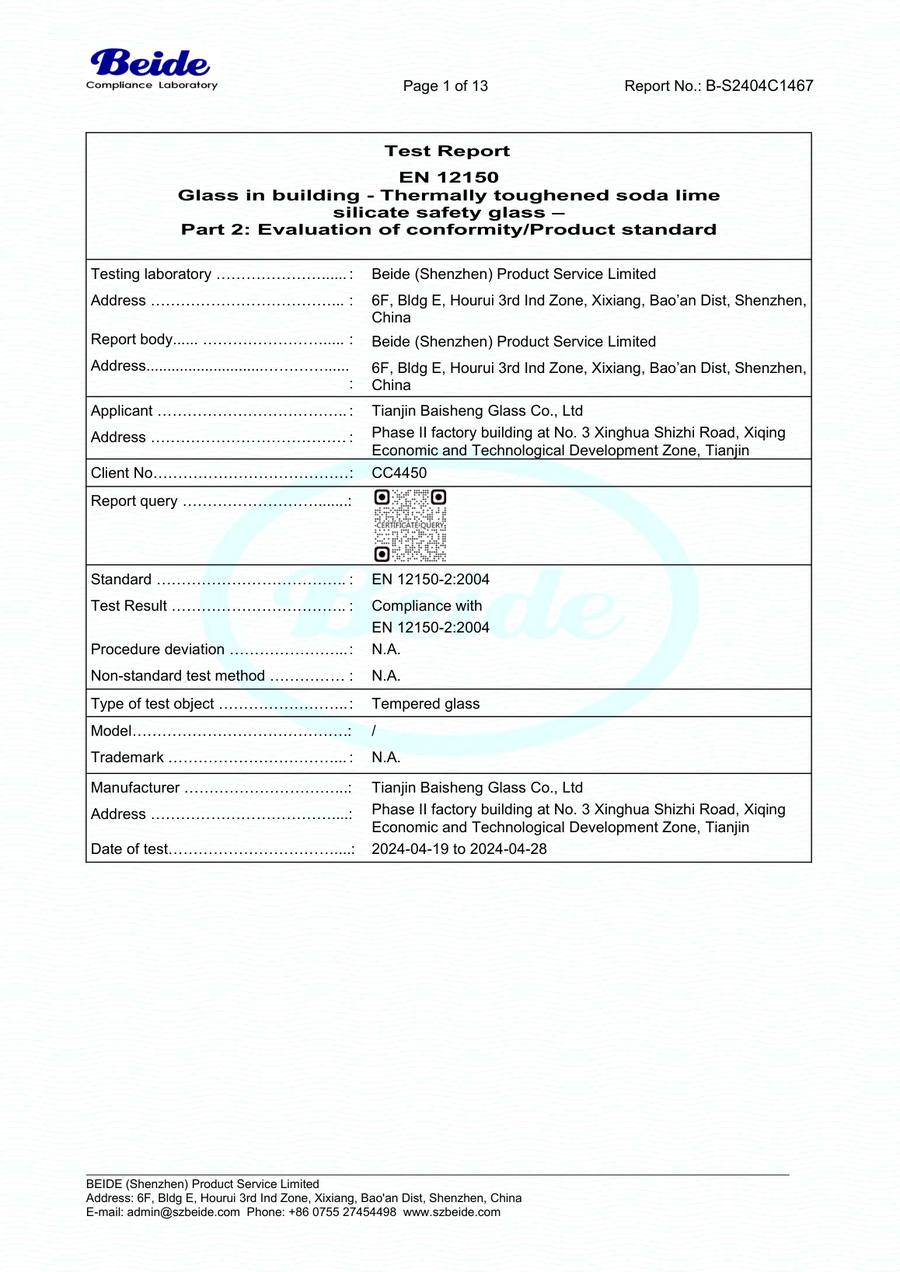
  • Glass: a tempered glass test report to EN 12150-2, with the report number on it — a document, not a logo on a slide.
  • Packing: the packing list is checked against the approved drawing before the container is sealed, and a pre-shipment photo set or video walkthrough of the kit is available on request.
  • Drawings: foundation, net-post socket, fence fixing and drainage details issued for your contractor, so the base is right before the container lands.
  • Lighting: a photometric plan giving lux or footcandle levels and uniformity across the court, not a fixture count.
  • Warranty: written terms for the court system against manufacturing defects and corrosion, confirmed per project in the quotation.
12 mm tempered glass test report EN 12150-2:2004, report B-S2404C1467 page 1
12 mm tempered glass — EN 12150-2:2004 test report B-S2404C1467, page 1.
Reports are issued per glass batch. Ask for the one that matches your order, along with the ISO 1461 galvanising certificate for the steel in the same shipment — if a supplier hesitates on those two documents, that is your answer.
Open the full-size report ↗

Seaside & beachfront court questions

It depends on exposure rather than a single distance: onshore wind, elevation and direct spray matter as much as metres. Tell us the distance to the surf line, the prevailing wind and whether the site takes spray, and we will set the corrosion class from that instead of a default.

Hot-dip galvanising to ISO 1461 at 80–100 µm is the correct base for a coastal court, but it is only half the specification — fasteners and fittings must be stainless, ideally 316 near the shoreline. A galvanised frame with galvanised bolts is the most common coastal failure we see.

A UV-stabilised wind screen on the windward side makes the court playable on days that would otherwise be lost. The screen must be pressure-equalised — a gap at the base or a perforated panel — so it does not act as a sail, and posts must be sized to your design wind speed.

Stop it at the boundary: a windward screen, a firm drainage edge, and a court raised above the surrounding ground. Choose a surface you can brush clear — on a sandy site, interlocking tiles brush and lift more easily than a bonded acrylic system.

Tiles on very sandy or exposed sites, because they can be brushed, lifted and individually replaced. A UV-stable cushioned acrylic surface is a good choice on sheltered coastal sites with a proper base, and it gives the truest bounce for competitive play.

Weekly brushing and drain checks, a freshwater hose-down monthly during onshore wind periods, a post-storm inspection of fixings and screens, and one annual check of fasteners and line contrast. Budget for it — on the coast, maintenance is what separates a ten-year court from a five-year one.

Send the site details — get a coastal court quotation in 12 hours

Tell us the distance to the water, the prevailing wind, the base situation and the court count. You will receive a coastal specification, drawings, a bill of materials with stainless grades and a cost breakdown.

Get a Quote → Chat on WhatsApp

Prefer an instant answer? Ask the AI assistant at the bottom-right.