Home / Pickleball Court Solutions / Cruise Ship

Pickleball Courts for Cruise Ships & Superyachts

Sports-deck courts that stay put in a Force 6, weigh what the naval architect allowed, and survive a decade of salt.

60 – 140 kgper court of steel
25 m/sdesign wind on upper decks
316stainless fasteners
2–3 daysinstall in port
Quick Answer: A cruise-ship pickleball court is a standard 20 × 44 ft playing area, usually laid out on an existing sports deck in one of two ways: interlocking tiles with wheeled net posts where the deck must convert back to basketball or events, or socket-mounted posts and a bonded surface on a dedicated court. The marine decisions are weight, wind and salt: component weights are issued per court so your naval architect can check deck loading; ball containment netting stops balls going over the side; and everything is hot-dip galvanised or marine-coated with 316 stainless fasteners. We supply drawings, weights and material certificates for your technical and safety review, and install in a port call or dry dock window.

Quick Summary

This page is written for cruise-line newbuilding and refit teams, deck and activities officers, naval architects and yacht managers. It covers deck layout and weight, the multi-use question, wind and motion, marine corrosion specification, ball containment, installation windows and spares. Dimensions follow USA Pickleball court specifications. Classification and flag-state approvals remain with your naval architect; our role is to supply the hardware, the weights and the documents they need.

Terms used on this page: Sports deck — the open deck area allocated to recreation — usually shared between sports Apparent wind — the wind a player feels, combining true wind and the ship's own speed Socket post — a net post that drops into a flush deck socket, leaving a covered hole when removed

Why pickleball belongs on the sports deck

A quarter of a basketball court, a handful of paddles, and a queue of guests every sea day.

Ship deck and open water beside a cruise ship sports area
On a moving deck the ball behaves differently, the wind is always against you, and anything loose ends up over the side.

Cruise lines have been adding pickleball for the same reason hotels have: it is the only racket sport that works on a deck with no run-off. The court is small enough to fit inside an existing sports area, the ball does not need chasing, and a guest who has never played can join a game on the first sea day. For activities teams, that means a programme item that fills a slot before breakfast and again before dinner, with two crew members and a bag of paddles.

The engineering, however, is nothing like a shore court. At sea the three constraints are weight, wind and salt, in that order. Weight is fixed by the naval architect long before a supplier is asked for a price; wind is higher at deck level than on any land site; and salt spray reaches places that rain on shore never does. Every specification decision on this page follows from those three.

There is an operational constraint too: you install in port, not at a shipyard. The kit has to arrive complete, in sections that fit the ship's lifts and stairwells, with everything numbered so two crew and a small contractor team can assemble it in a two-day call.

Deck arrangements and multi-use

Five configurations, from a dedicated court to a lounge conversion for bad-weather days.

Deck arrangement Space Setup / takedown Best for
Dedicated court, bonded surface34 × 64 ftpermanent — net onlyships with deck space and firm demand for pickleball
Shared sports deck, tiles + wheeled posts34 × 64 ft15–25 min with two crewthe standard solution where basketball and events also use the deck
Two courts on a sports deck68 × 64 ft30–40 minlarger ships running guest tournaments
Half court / practice wall20 × 30 ftpermanent or tiledyachts and smaller ships with limited deck
Indoor lounge conversion34 × 64 ft, headroom 6 m+tiles on a trolleybad-weather programming without using open deck

The choice between a bonded surface and tiles is usually made by the deck's other uses, not by pickleball. If the sports deck also hosts basketball, football and evening events, tiles with wheeled net posts are the practical answer: the court is set up in fifteen minutes and lifted off the deck before the first event. If the deck is dedicated, a socket-mounted post and a bonded surface give the best playing feel and the least crew time.

Whatever the arrangement, keep the storage position within a few metres of the court. Tiles that have to travel along a deck or up a lift are tiles that stop being used.

Court dimensions on a constrained deck

USA Pickleball court specifications, with the deck-specific note on run-off.

Element Imperial Metric Notes for this site
Playing court20 × 44 ft6.10 × 13.41 mIdentical for singles and doubles; the part you paint
Non-volley zone (kitchen)7 ft each side2.13 mFull 20 ft width; mark before the surface is sealed
Minimum footprint30 × 60 ft9.14 × 18.29 m5 ft side buffer, 8 ft behind each baseline
Recommended footprint34 × 64 ft10.36 × 19.51 m7 ft sides, 10 ft behind baselines — use it wherever space allows
Tournament footprint40 × 64 ft12.19 × 19.51 mFor centres that will host sanctioned events
Net & posts36 in / 34 in high0.91 m / 0.86 mPosts 22 ft apart, max 3 in diameter, 2 in white top tape

On a deck the buffers are usually the first thing to be cut, and that is a legitimate compromise: pickleball is played inside the court, and a 5 ft side buffer is usable play even if it is tight. What should not be cut is the area behind each baseline — 8 ft minimum, 10 ft preferred — because that is where the serve is received and where players move at speed. Overhead, allow at least 6 m of clear height for a full lob; on an upper deck with a superstructure, check the structure drawings before fixing the court position.

Wind, salt and motion: the marine specification

Six requirements that separate a deck court from a shore court.

Requirement Specification Why it matters at sea
Weightcomponent weights issued per court and per palletyour naval architect needs real numbers, not estimates, for deck loading
Structurehot-dip galvanised steel to ISO 1461, 80–100 µm, with marine topcoatsalt spray reaches every surface, and wind-driven spray reaches the inside of posts
Fasteners316 stainless throughout304 and galvanised bolts fail quickly in the splash zone
Windposts and base plates sized to the design wind speed you give us; pressure-equalising screenupper decks see far higher wind than an equivalent shore site
Containment10 ft fence plus 12–15 ft netting on the exposed sidesa ball over the side is gone — and guests chasing balls near a rail is a safety matter
Surfacenon-slip, marine-grade tiles or bonded system with drainagewet decks, spray and rain; standing water is both a slip risk and a corrosion driver

Two further points worth putting in the specification document. First, weights: request the weight of every component per court and per pallet at the enquiry stage, in writing, so your naval architect can check the deck loading and the crane lift in port. Second, documentation: material certificates for the steel and stainless parts, coating certificates for the galvanising, and dimensional drawings. We supply these as standard; classification and flag-state approvals remain with your team, and we provide what their review requires.

On motion, the practical detail is the ball, not the court: a pickleball behaves oddly in a pitching ship and in apparent wind, so clinic sessions often teach a shorter, flatter game on sea days. Guests adapt in minutes, which is why the clinics fill.

Installing in a port call or a dry dock

Two days from pallet to playable court — if the kit is planned for the ship, not for the yard.

  1. Pre-shipment: the kit leaves in labelled, numbered sections sized for the ship's lifts and stairwells, with an assembly drawing and a photo sequence. Weight per pallet is confirmed to your team before dispatch.
  2. Day 1: deck survey, protective matting along the route, sockets fitted or tile base laid out, fence posts and panels assembled. The fence is usually the biggest single task.
  3. Day 2: net system, containment netting, line check, lighting if fitted, and a handover walk-through with the deck team.
  4. Handover pack: an inspection sheet, torque values, spares list and a short video of the assembly, so the ship can repeat part of it without us if a panel is ever damaged.

If the window is a dry dock, we can supply in larger sections and complete more of the assembly ashore. Tell us at enquiry which window you are targeting — it changes both the packing plan and the quotation.

Sea-day programming that fills the court

Four formats that work on board, and the crew time each one costs.

  • Open play sessions, twice daily: the deck team opens the court, puts out paddles and sets up a rotation. The lowest-effort format and the one that reaches the most guests.
  • Beginner clinics: 45 minutes, one instructor, four to eight guests. Fills the court and sells the next session.
  • Guest tournament: a one-page ladder over two sea days, mixed doubles, with a small prize. Very popular on longer itineraries and easy to repeat.
  • Family and teen slots: pickleball is one of the few sports where a grandparent and a teenager can play a competitive game together — a genuinely useful item for multi-generational groups.

Budget the consumables with the court: paddles with a grip that survives sun and salt, outdoor balls, a mesh ball bag, and a storage locker that keeps everything in one place. On a ship, equipment that lives in three different lockers is equipment that goes missing.

What to send us for a marine court quote

Six items, and the quotation arrives with weights and drawings.

  1. Deck plan or photograph with the proposed court position, and the clear height above it.
  2. Deck build-up: which deck, surface finish, and whether sockets may be cut.
  3. Weight allowance and the ship's lift and route dimensions.
  4. Design wind speed, if your naval architect has a figure to hand.
  5. Whether the deck must convert to other sports or events.
  6. Installation window: port call, itinerary dates or dry dock.

Use the quote form or WhatsApp. We will send a specification, component weights per pallet, drawings and a spares list — the pack your technical team needs before an order can be raised.

The factory, the quality checks and the paperwork behind your court

Marine orders live and die on documents: weights, certificates, drawings and dates. All four come with the quotation.

PeakPadel is the export brand of Shanghai Super Energy Sports Facilities Co., Ltd. We work with partner factories in Hebei and Tianjin: 8 production lines, a 12,000 m² workshop and around 1,500 complete court sets a year, with courts playing in more than 30 countries. For ship and yacht projects we are usually asked for component weights per pallet, material and coating certificates, and a spares list that can be held on board. All are supplied with the quotation so your technical team can review before committing.

Documents that travel with an order:

  • Galvanising: hot-dip galvanised to ISO 1461 at 80–100 µm, with the per-batch coating certificate for the steel in your order.
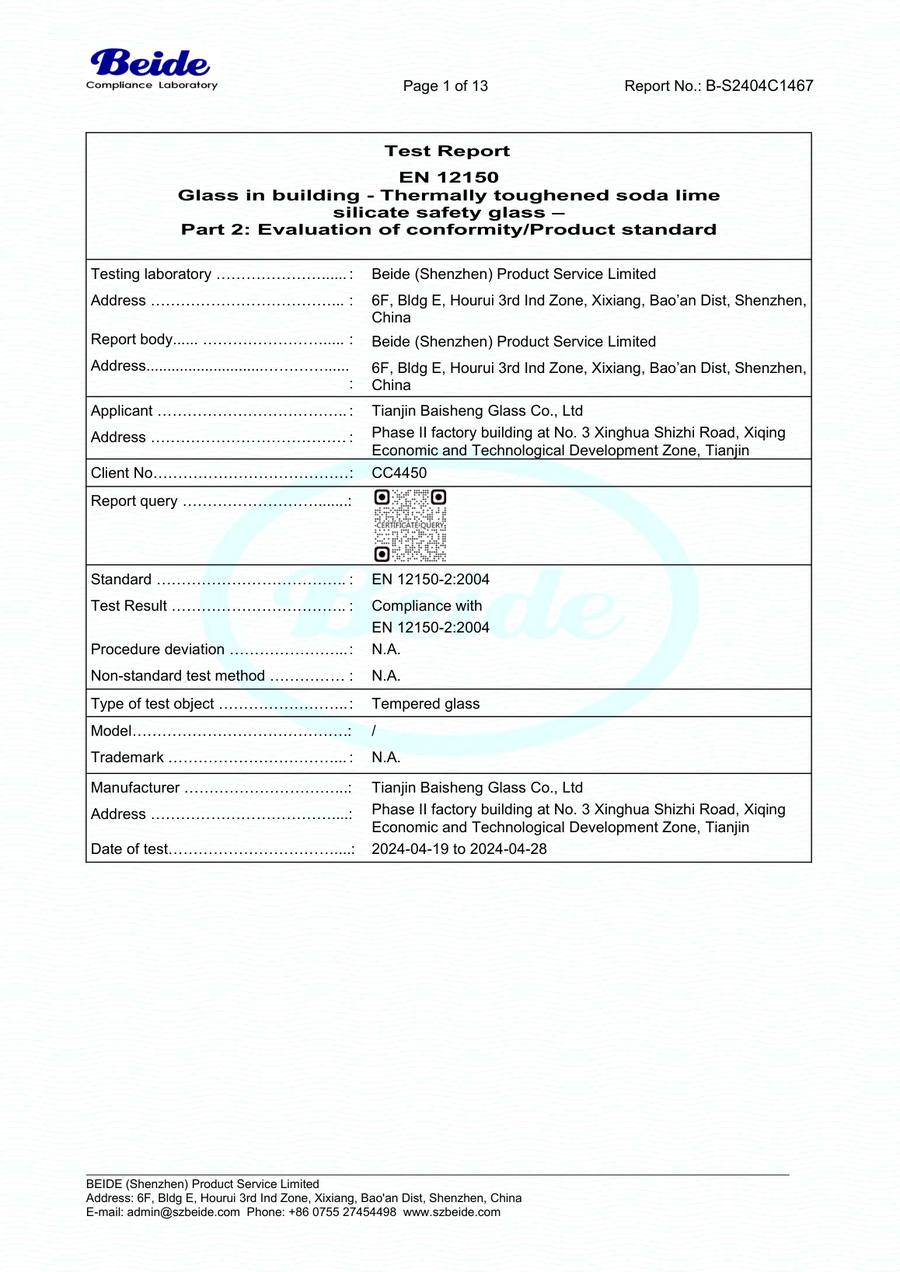
  • Glass: a tempered glass test report to EN 12150-2, with the report number on it — a document, not a logo on a slide.
  • Packing: the packing list is checked against the approved drawing before the container is sealed, and a pre-shipment photo set or video walkthrough of the kit is available on request.
  • Drawings: foundation, net-post socket, fence fixing and drainage details issued for your contractor, so the base is right before the container lands.
  • Lighting: a photometric plan giving lux or footcandle levels and uniformity across the court, not a fixture count.
  • Warranty: written terms for the court system against manufacturing defects and corrosion, confirmed per project in the quotation.
12 mm tempered glass test report EN 12150-2:2004, report B-S2404C1467 page 1
12 mm tempered glass — EN 12150-2:2004 test report B-S2404C1467, page 1.
Reports are issued per glass batch. Ask for the one that matches your order, along with the ISO 1461 galvanising certificate for the steel in the same shipment — if a supplier hesitates on those two documents, that is your answer.
Open the full-size report ↗

Cruise ship & yacht court questions

It depends on the arrangement. A tiles-and-wheeled-posts court is the lightest option because it needs no concrete base; a permanent court with galvanised steel posts and a fence is heavier. We issue a component-by-component weight schedule per court and per pallet at the enquiry stage — your naval architect decides the allowance, we design to it.

Containment netting to 12–15 ft on the sides facing open deck or a rail, combined with a standard 10 ft fence. It is a small line item next to a guest leaning over a rail to fish a ball out of the water, and it also keeps the game moving on windy decks.

Yes — that is the most common arrangement. Interlocking tiles plus wheeled net posts let two crew set up a court in 15–25 minutes and clear the deck for an event afterwards. If the deck stays dedicated, socket posts and a bonded surface are cleaner and faster in daily use.

Playable, with adjustments: containment netting, a wind screen on the exposed side, and a shorter, flatter style of play that instructors teach in the first clinic. We size posts and base plates to the design wind speed you give us, and recommend a pressure-equalising detail so a screened fence does not act as a sail.

A port call is usually two days: day one for the fence and base, day two for the net, containment and handover. A dry dock allows larger pre-assembly and larger shipping sections. We ship ahead of the window, labelled and numbered, with an assembly drawing and photo sequence — and we can supply a spares kit for on-board retention.

Yes: material certificates for steel and stainless components, hot-dip galvanising certificates to ISO 1461, dimensional drawings and component weights. Approvals themselves remain with your naval architect and flag state; we supply whatever their review process requires, in writing.

Send the deck plan — get a marine court quotation in 12 hours

Tell us the deck, the clear height, the weight allowance and the installation window. You will receive a specification, component weights, drawings and a spares list.

Get a Quote → Chat on WhatsApp

Prefer an instant answer? Ask the AI assistant at the bottom-right.